Life Sciences (Grade 12 Sociology and Economics, Literature and Humanities, Lebanon) · Chapter 3 · Tutorial exercise
Waking up after an operation
Nervous communication · C. Synthesis problem: a poison and its antidote · level 3 (hard)
Statement
During some surgical operations, anesthetists give the patient a substance derived from curare, which relaxes the muscles. At the end of the operation, they may give a second substance, the “antidote,” so that the muscles work again normally.
Document A — The action of curare. Curare binds to the acetylcholine receptors of the muscle membrane, without stimulating them.
Document B — An experiment on a nerve–muscle preparation. The nerve is stimulated regularly and the force of the contractions of the muscle is measured. Curare is added at time 5 min; the antidote at time 15 min.
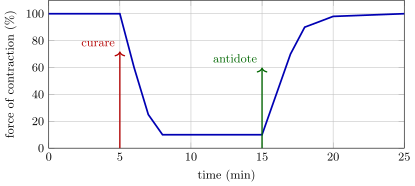
Document C — The action of the antidote. The antidote blocks the enzyme that normally destroys acetylcholine in the synaptic cleft.
- Describe how the force of contraction changes after curare is added.
- Explain, using document A, the effect of curare.
- Describe the effect of the antidote (document B).
- Using document C, explain how the antidote can restore the contractions although curare is still present.
- Explain why a patient who has received curare must be helped to breathe during the operation.
- Give the four ways, seen in this chapter, in which a chemical substance can perturb a synapse, and classify curare and the antidote.
Solution
- After the addition of curare, the force of contraction falls from 100% to about 10% in three minutes, then stays very low until 15 min.
- The nerve still releases acetylcholine, but curare occupies the receptors of the muscle membrane: acetylcholine can no longer bind to them, the message does not pass to the muscle, which hardly contracts any more.
- After the addition of the antidote, the force of contraction rises again from 10% to about 100% in five minutes.
- The antidote prevents the destruction of acetylcholine: acetylcholine accumulates in the cleft and stays there longer. Being more abundant, it binds to the receptors left free by curare and stimulates the muscle again.
- The muscles of breathing (diaphragm, muscles between the ribs) are also controlled by nerve–muscle synapses with acetylcholine: curare paralyzes them, so the patient cannot breathe alone and must be ventilated by a machine.
- A substance can imitate a neurotransmitter, block its receptors, prevent its release, or prevent its elimination. Curare blocks the receptors of acetylcholine; the antidote prevents the elimination of acetylcholine.
What the exercise establishes: analyzing the action of two substances that perturb the same synapse in opposite directions.
Similar exercises
- Reading an action potential solved
- Fast fibers, slow fibers solved
- A pressure on the skin solved
- From nerve to muscle solved
- One neuron, two synapses solved
The course of the chapter · All the exercises of the chapter