Life Sciences (Grade 12 Sociology and Economics, Literature and Humanities, Lebanon) · Chapter 4 · Tutorial exercise
Nicotine: from the synapse to dependence
Substance abuse · B. The drugs' mode of action (LB-SE only) · level 3 (hard)
Statement
Three documents describe the action of nicotine.
Document A. Nicotine reaches the brain a few seconds after a puff. It binds to certain acetylcholine receptors located on the dopamine neurons of the reward circuit and stimulates them.
Document B. Release of dopamine in the reward circuit of rats after a meal or after the injection of a substance (relative to the normal level, 100).
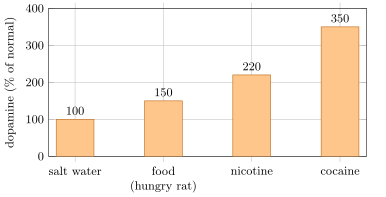
(illustrative data showing the trend described by research)
Document C. In regular smokers, the number of certain receptors changes. A few hours after the last cigarette, the smoker becomes irritable, anxious, has difficulty concentrating and feels a strong desire to smoke; these disorders are strongest in the first days after stopping, then decrease over a few weeks. Nicotine patches deliver a small, steady dose of nicotine through the skin.
- Name the mode of action of nicotine at the synapse (document A).
- Compare the effect of nicotine with that of food in a hungry rat, and explain the pleasure felt by the smoker.
- Classify nicotine and cocaine according to their mode of action.
- Explain, at the level of the synapse, why a regular smoker ends up smoking more cigarettes.
- Name the disorders described in document C and explain them.
- Explain how nicotine patches can help a person to stop smoking.
- Write a short paragraph explaining to a young person why one cigarette “just to try” can be the beginning of a dependence.
Solution
- Nicotine imitates acetylcholine: it binds to certain acetylcholine receptors and stimulates the dopamine neurons.
- Food in a hungry rat raises dopamine to 150% of normal; nicotine raises it to 220%. Nicotine over-stimulates the reward circuit, more than a natural reward: the smoker feels pleasure.
- Nicotine imitates a neurotransmitter (acetylcholine). Cocaine blocks the reuptake of a neurotransmitter (dopamine). Both increase dopamine in the reward circuit.
- The repeated over-stimulation of the synapses leads the neurons to modify their receptors and to reduce their response: the same quantity of nicotine has less effect. This is tolerance: the smoker increases the number of cigarettes.
- They are the disorders of the withdrawal syndrome. Without nicotine, the reward circuit, adapted to the drug, is under-stimulated: the person feels discomfort and an irresistible need to smoke again. This is dependence.
- The patch supplies nicotine without smoke (without tar or carbon monoxide), in a small and steady dose: it reduces the withdrawal disorders while the brain readapts, and the dose is then decreased gradually.
- For example: “Nicotine acts on your brain within seconds: it imitates a natural messenger and floods the reward circuit with dopamine, more than a natural pleasure. Your brain quickly learns to ask for this pleasure again. If you repeat, it adapts: the same cigarette has less effect, you need more, and without it you feel bad. Dependence settles all the more easily as your brain is still developing. Not starting is much easier than stopping.”
What the exercise establishes: following the action of nicotine from the synapse to tolerance and dependence, and justifying the means of stopping.
Similar exercises
- When can he drive? solved
- Cigarettes and lungs solved
- Starting young solved
- Morphine and the endorphin receptors solved
- Where does dopamine go? solved
The course of the chapter · All the exercises of the chapter