Life Sciences (Grade 12 Sociology and Economics, Literature and Humanities, Lebanon) · Chapter 4 · Tutorial exercise
When can he drive?
Substance abuse · A. Drug addiction: dependence, tolerance and the effects of tobacco and alcohol · level 2
Statement
A man drinks several glasses of alcohol at a dinner ending at 10 p.m. His blood alcohol concentration is measured every hour (illustrative data, orders of magnitude).
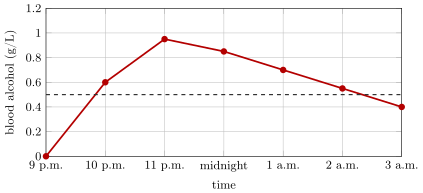
The dashed line marks 0.5 g/L, the limit above which driving is forbidden in Lebanon.
- Read the maximum blood alcohol concentration and the time at which it is reached.
- Calculate how much the concentration decreases per hour between 11 p.m. and 3 a.m.
- Determine from what time the man is below the legal limit.
- Explain why, even below 0.5 g/L, it is safer not to drive after drinking.
- A young driver who has had his license for one year drinks one glass. Can he drive? Justify.
Solution
- The maximum is 0.95 g/L, reached at 11 p.m., one hour after the end of the dinner.
- Between 11 p.m. and 3 a.m., it goes from 0.95 to 0.40 g/L: a decrease of 0.55 g/L in 4 hours, that is, about 0.14 g/L per hour.
- At 2 a.m. it is 0.55 g/L, at 3 a.m. 0.40 g/L: the man goes below 0.5 g/L between 2 a.m. and 3 a.m., four to five hours after the end of the dinner.
- Alcohol slows reactions and reduces vigilance from low concentrations: the reaction time is already longer at 0.2 or 0.5 g/L. According to the WHO, no consumption of alcohol is risk-free.
- No: in Lebanon, young drivers must not drink any alcohol before driving.
What the exercise establishes: reading a curve of blood alcohol concentration and relating it to the rules of road safety.
Similar exercises
- Four portraits solved
- Cigarettes and lungs solved
- Starting young solved
- Morphine and the endorphin receptors solved
- Where does dopamine go? solved
The course of the chapter · All the exercises of the chapter