Mathematics (Grade 10, Lebanon) · Chapter 2 · Direct application of the course
Cumulative polygons and graphical reading
Graphical representation of a statistical distribution · level 2
Statement
The duration (in minutes) of the morning commute of employees is summarized below:
| Duration (in min) | ||||
|---|---|---|---|---|
| Frequency |
- Draw up the table of the increasing (ICF) and decreasing (DCF) cumulative frequencies at the boundaries .
- Draw in the same coordinate system the ICF polygon and the DCF polygon, and determine the coordinates of their point of intersection.
- By graphical reading and then by linear interpolation, estimate the number of employees whose commute lasts less than minutes.
Solution
- At the successive boundaries , the cumulative frequencies are:
| Boundary (in min) | |||||
|---|---|---|---|---|---|
| ICF () | |||||
| DCF () |
- At min, the increasing cumulative frequency and the decreasing cumulative frequency are both equal to : the two polygons intersect exactly at the point .
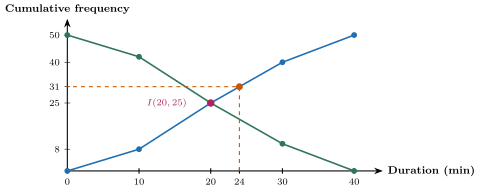
- The value min belongs to the class , on which the ICF polygon joins to : the frequency increases by employees for minutes. Between and min (i.e. minutes), it therefore increases by employees, which gives employees with a commute of less than minutes.
Similar exercises
- Histogram with classes of unequal widths and frequency density solved
- Problem: Rainfall study and cumulative polygons in the Litani basin solved
- Pie chart and semicircular chart solved
- Rebuilding the frequencies from the cumulative values solved
- Histogram with classes of unequal widths solved
The course of the chapter · All the exercises of the chapter