Mathematics (Grade 10, Lebanon) · Chapter 21 · Tutorial exercise
Cutting a block of limestone in Batroun: plane section and study in true size
Plane sections of common solids · C. Point-by-point construction of plane sections of polyhedra · level 3 (hard)
Statement
A stonecutter in Batroun shapes a block of limestone in the form of a rectangular prism with a square base , whose bottom base and top face are squares of side , and whose four vertical edges measure . On the upper front edge , the stonecutter marks the point such that (and so ), then saws the block along the plane passing through the diagonal of the bottom base and through the point .
Part A — Construction of the plane section of the block by the plane . 1) Justify that, in the plane of the front face , the lines and intersect at a point located above . Applying Thales' theorem in the plane , calculate the ratio and deduce the lengths and . 2) Prove that the line is the line of intersection of the planes and . Deduce that the cutting plane meets the edge at a point , calculate the distances and , then specify the nature of the cross-section polygon of the block by the plane .
Part B — Extraction in true size and area of the cut face . 3) Working in the planes and , calculate the exact lengths of and of , and prove that the lines and are parallel (using for example the converse of Thales' theorem in the triangle ). 4) Calculate the exact lengths of the lateral sides and of the section, and deduce the exact nature of the quadrilateral . 5) Extract the quadrilateral in true size. Denoting by the orthogonal projection of onto , calculate the length , the height of the quadrilateral , its exact perimeter and its exact area (in ).
Solution
Strategy. In part A, the auxiliary point provides the transition between the front face and the right lateral face . In part B, moving to the planes of the faces gives the four sides of the section , which is an isosceles trapezoid whose height and area are calculated in true size by the Pythagorean theorem.
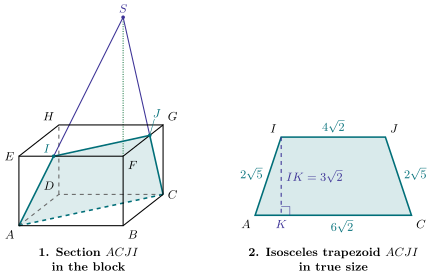
Part A — Construction of the plane section of the block by the plane .
1) Point of intersection and lengths and . In the front rectangle , the lines and are parallel. Since , the line , which passes through , is distinct from : it is therefore not parallel to , nor consequently to . The coplanar lines and therefore meet at a point . In the bow-tie triangles and (with ), Thales' theorem gives: Since , we obtain .
2) Trace on the face and position of the point .
- The point belongs to the line and to the line . Since the vertex also belongs to the two planes and , their line of intersection is the line .
- In the plane , the segment meets the side (parallel to ) at a point . By Thales' theorem in the triangles and : and so . The traces of the plane on the four faces cut are , , and : the section of the block is the quadrilateral .
Part B — Extraction in true size and area of the cut face .
3) Lengths of and and parallelism.
- In the square of side , the diagonal measures .
- In the square of side , the triangle is an isosceles right triangle with the right angle at , with , hence: Moreover, in the triangle , we have and : by the converse of Thales' theorem, . Now (opposite sides of the diagonal rectangle ), so by transitivity .
4) Lengths of and and nature of . In the rectangle , the triangle is right-angled at with and ; in the rectangle , the triangle is right-angled at with and . By the Pythagorean theorem: Since with and , the quadrilateral is an isosceles trapezoid with bases and .
5) Height , perimeter and area of .
- The perimeter of the section equals:
- By symmetry of the isosceles trapezoid , the orthogonal projection of onto satisfies: In the triangle right-angled at , the Pythagorean theorem gives the height of the trapezoid:
- The exact area of the cut face is therefore a whole number of square decimeters:
What the problem establishes. The construction by extending an edge () and Thales' theorem make it possible to determine the exact position of the fourth vertex of a plane section, then the extraction in true size reduces the calculation of the area of the section to that of a plane isosceles trapezoid.
Similar exercises
- Intersection of two planes and collinearity of three points (Desargues' theorem in space) solved
- Extracting planes in a rectangular prism: diagonals, angle and distance from a vertex to a diagonal solved
- Median plane of a regular tetrahedron: distance between two opposite edges and volume solved
- Plane section of a pyramid with a square base and concurrency on the height solved
- Pentagonal section of a cube and exact determination of the vertices by Thales' theorem solved
The course of the chapter · All the exercises of the chapter