Mathematics (Grade 10, Lebanon) · Chapter 21 · Direct application of the course
Extracting a plane figure and calculating the area of a section in a cube
Plane sections of common solids · level 2
Statement
Let be a cube with edge . We denote by the midpoint of and by the midpoint of .
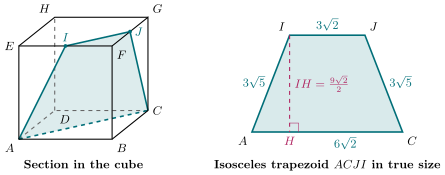
- Determine and draw the section of the cube by the plane .
- What is the exact nature of the quadrilateral in space?
- Extract the quadrilateral in true size and calculate its perimeter and its exact area.
Solution
- In the plane , the segment joins the midpoints of and : by the midpoint theorem in the triangle , we have and . Now in the diagonal rectangle , we have and , hence : the two strictly parallel lines and are therefore coplanar, which proves that the point belongs to the plane . The traces of the plane on the faces of the cube are then (on ), (on ), (on ) and (on ): the required section is the quadrilateral .
- Since with , the quadrilateral has two parallel opposite sides of different lengths: it is a trapezoid with bases and . Moreover, in the square faces and of side , the right triangles (right-angled at , with and ) and (right-angled at , with and ) are congruent, so:
The quadrilateral is therefore an isosceles trapezoid.
- In the cube with edge , the diagonal of the square measures , so . The perimeter of the section equals:
On the plane figure extracted from the isosceles trapezoid , let be the orthogonal projection of onto . By symmetry of the isosceles trapezoid, we have:
In the triangle right-angled at , the Pythagorean theorem gives the height of the trapezoid:
The area of the trapezoidal section is therefore:
Similar exercises
- Pentagonal section of a cube and exact determination of the vertices by Thales' theorem solved
- Cutting a block of limestone in Batroun: plane section and study in true size solved
- Lines of intersection of two planes in a pyramid solved
- Moving to the plane setting and Menelaus' theorem in a tetrahedron solved
- Section of a tetrahedron passing through a point inside a face solved
The course of the chapter · All the exercises of the chapter