Mathematics (Grade 10, Lebanon) · Chapter 21 · Tutorial exercise
Intersection of two planes and collinearity of three points (Desargues' theorem in space)
Plane sections of common solids · A. Determination of a plane, coplanarity and intersection of two planes · level 2
Statement
Let be a tetrahedron with apex and base . On the edges , and , we place three points , and (distinct from the vertices) such that:
1) Working successively in the planes of the three lateral faces , and , prove that the line meets the line at a point , that meets at a point and that meets at a point .
2) Prove, without any calculation, that the three points , and are collinear.
3) In the plane , we draw through the line parallel to , which meets the line at a point . Applying Thales' theorem twice in the plane , calculate the ratio , then the ratio , and specify the exact position of relative to the segment .
Solution
Strategy. To prove that three points , , obtained by intersections of lines are collinear in space, we show that all three belong to two distinct planes and : they are then necessarily located on the line of intersection .
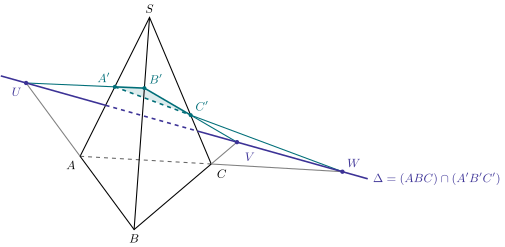
1) Existence of the points of intersection , and .
- In the plane of the face , the lines and are coplanar. Moreover, and : since , the contrapositive of Thales' theorem proves that is not parallel to . They therefore intersect at a unique point .
- Similarly, in the plane , , so the coplanar lines and meet at a point .
- Finally, in the plane , , so the coplanar lines and meet at a point .
2) Collinearity of the points , and . Consider the two planes and :
- the point belongs to and to , so ;
- the point belongs to and to , so ;
- the point belongs to and to , so . The two planes and being distinct, their intersection is a line . The three points , and , which all belong to , are therefore collinear.
3) Calculating the ratio in the plane . Let us extract the plane and draw through the parallel to , which meets at :
- since , we have . In the triangles and in a Thales configuration (with ):
- since is the midpoint of , we have , hence ;
- finally, in the triangles and in a Thales configuration (with ):
The point does not belong to the segment : the line already meets the sides and of the triangle at and , and a line that passes through no vertex of a triangle cannot meet all three of its sides. The points , , are therefore collinear with and : the point is located on the side of , and . The point is therefore the midpoint of the segment ( is the reflection of in ).
What the exercise establishes. The axiom of intersection of two planes turns a question of collinearity of three points into a simple check of membership in the two planes; and to calculate a ratio on a transversal of a triangle (Menelaus configuration), it suffices to draw through a vertex a parallel to the opposite side to create two successive Thales configurations.
Similar exercises
- The four ways of determining a plane, coplanarity and lines of intersection in a cube solved
- Extracting planes in a rectangular prism: diagonals, angle and distance from a vertex to a diagonal solved
- Median plane of a regular tetrahedron: distance between two opposite edges and volume solved
- Plane section of a pyramid with a square base and concurrency on the height solved
- Pentagonal section of a cube and exact determination of the vertices by Thales' theorem solved
The course of the chapter · All the exercises of the chapter