Mathematics (Grade 10, Lebanon) · Chapter 21 · Tutorial exercise
Median plane of a regular tetrahedron: distance between two opposite edges and volume
Plane sections of common solids · B. Moving from the space setting to the plane setting and calculations in true size · level 2
Statement
Let be a regular tetrahedron with edge . We denote by the midpoint of the edge and by the midpoint of the opposite edge .
1) Working in the equilateral faces and , calculate the exact lengths of the medians and , and deduce the nature of the triangle contained in the median plane .
2) Extract the triangle in true size, justify that the line is perpendicular to (and likewise perpendicular to ), and calculate the exact length of the segment (called a bimedian of the tetrahedron).
3) Calculate the exact area of the triangle . Noticing that the plane divides the tetrahedron into two tetrahedra and with common base and respective heights and , recover the exact volume of the regular tetrahedron .
Solution
Strategy. The plane is the perpendicular bisector plane of the segment : the two faces and provide the equal sides of the isosceles triangle , which we extract in true size to apply the Pythagorean theorem to it.
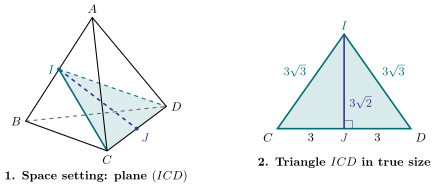
1) Lengths and and nature of . The faces and are equilateral triangles of side , and , are median-altitudes of them: Since , the triangle is isosceles at (with base ).
2) Orthogonality and calculation of . In the triangle isosceles at , the median relative to the base (since is the midpoint of ) is also the altitude: so (and by the same reasoning in the triangle isosceles at , we have : is the common perpendicular to the two opposite edges and ). In the triangle right-angled at , we have and . By the Pythagorean theorem:
3) Area of and volume of .
- The area of the triangle equals:
- In the equilateral triangles and , we have and , so the line is perpendicular to the plane at . The segments and are therefore the respective heights of the tetrahedra and relative to their common base , hence: that is:
What the exercise establishes. In a regular tetrahedron with edge , the median triangle (with sides ) yields with a single Pythagorean theorem the distance between two opposite edges and the volume .
Similar exercises
- The four ways of determining a plane, coplanarity and lines of intersection in a cube solved
- Intersection of two planes and collinearity of three points (Desargues' theorem in space) solved
- Extracting planes in a rectangular prism: diagonals, angle and distance from a vertex to a diagonal solved
- Plane section of a pyramid with a square base and concurrency on the height solved
- Pentagonal section of a cube and exact determination of the vertices by Thales' theorem solved
The course of the chapter · All the exercises of the chapter