Mathematics (Grade 10, Lebanon) · Chapter 21 · Tutorial exercise
Pentagonal section of a cube and exact determination of the vertices by Thales' theorem
Plane sections of common solids · C. Point-by-point construction of plane sections of polyhedra · level 2
Statement
Let be a cube with edge . We place the point at the midpoint of the edge (), the point on the edge such that (so ) and the point on the edge such that (so ). We study the section of the cube by the plane .
1) In the plane of the right lateral face , the line meets the line at a point located above . Calculate the length , then justify that in the plane of the front face , the line meets the edge at a point , and calculate the distance .
2) In the plane of the top face , the line meets the line at a point located beyond . Calculate the length , then justify that in the plane of the back face , the line meets the edge at a point , and calculate the distance .
3) Represent the cube, the auxiliary points and , as well as the cross-section polygon , respecting the visibility conventions, and calculate the exact lengths of the five sides of the pentagon .
Solution
Strategy. Each extension of an edge creates in the plane of a square face of the cube a Thales configuration (bow-tie around or , or triangle around ) all of whose ratios are known, which makes it possible to check by calculation that the new vertices and do fall on the segments and (lengths between and ).
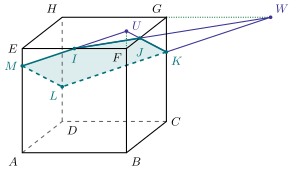
1) Calculating in , then in .
- In the plane , the lines and are parallel, and the lines and meet at . By Thales' theorem in the triangles and :
- The point belongs to and to : the line is therefore the trace of the plane on the plane . In this plane, is parallel to , and the lines and meet at (midpoint of , so ). By Thales' theorem in the triangles and : Since , the point does belong to the segment (with ).
2) Calculating in , then in .
- In the plane , is parallel to , and the lines and meet at . By Thales' theorem in the triangles and :
- The point belongs to and to : the line is therefore the trace of on the plane . In this plane, the point belongs to the segment with , and is parallel to . By Thales' theorem in the triangles and : Since , the point does belong to the segment (with ).
3) Lengths of the five sides of the cross-section pentagon . Applying the Pythagorean theorem in each of the five square faces of the cube met by the plane :
- in (triangle right-angled at , ): ;
- in (triangle right-angled at , ): ;
- in (triangle right-angled at , ): ;
- in (right trapezoid where the difference of the heights is and the width is ): ;
- in (right trapezoid where and ): . (We notice in passing that and , because these pairs of sides are carried by parallel opposite faces of the cube!)
What the exercise establishes. Combining the method of auxiliary points ( and ) with Thales' theorem makes it possible both to construct the section geometrically and to calculate to the nearest millimeter the position of each vertex on the edges of the cube.
Similar exercises
- Intersection of two planes and collinearity of three points (Desargues' theorem in space) solved
- Extracting planes in a rectangular prism: diagonals, angle and distance from a vertex to a diagonal solved
- Median plane of a regular tetrahedron: distance between two opposite edges and volume solved
- Plane section of a pyramid with a square base and concurrency on the height solved
- Cutting a block of limestone in Batroun: plane section and study in true size solved
The course of the chapter · All the exercises of the chapter