Mathematics (Grade 10, Lebanon) · Chapter 21 · Tutorial exercise
Plane section of a pyramid with a square base and concurrency on the height
Plane sections of common solids · C. Point-by-point construction of plane sections of polyhedra · level 2
Statement
Let be a pyramid whose base is a square with center . We place the point on the edge such that , the point at the midpoint of () and the point on the edge such that . We want to construct the section of the pyramid by the plane .
1) Justify that the line meets the line at a point and that the line meets the line at a point . What is the line of intersection of the plane with the plane of the base ?
2) Explain how to construct, using the line (or using the point of intersection of the segment with the line in the diagonal plane ), the point of intersection of the plane with the edge , then draw the cross-section quadrilateral .
3) In the diagonal plane , we draw through the line parallel to , which meets at its midpoint . The parallel to drawn through meets the line at a point . Calculate the ratios and , then the ratio , and deduce the position of on .
Solution
Strategy. To determine the fourth vertex of the section of a pyramid with a quadrilateral base, we have two complementary methods: either extend and to the base plane to draw the outer trace , or use the point inside the diagonal plane , because the line is then contained both in and in the second diagonal plane and meets directly at without leaving the pyramid!
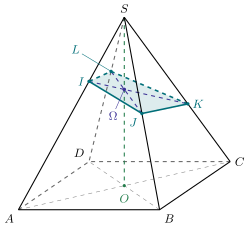
1) Line of intersection . In the triangle , , so is not parallel to and meets it at a point . Similarly, in , , so meets at a point . The line of intersection of the planes and is therefore the line .
2) Two equivalent constructions of the fourth vertex .
- Method 1 (by the outer trace ): in the plane , the line meets the line at a point (and at a point ). In the plane of the face , the line then meets the edge at the point .
- Method 2 (by the diagonal planes and , shown in the figure): in the triangle , the segment meets the median at a point . Since and , the whole line is contained in the plane . Now and , so the line is also contained in the diagonal plane : it meets the edge at the required point , and the section is the quadrilateral .
3) Position of on by Thales' theorem in . In the triangle , is the midpoint of ; the parallel to drawn through is therefore the midline and meets at its midpoint (), with . Let us draw through the parallel to : it meets the line at a point . The lines and are parallel (both parallel to ), and are on , and on ; Thales' theorem, with vertex , gives: The point is therefore on the ray , beyond , with . Since , in the bow-tie triangles and (with ), Thales' theorem gives: Since , , hence .
What the exercise establishes. In a pyramid with a quadrilateral base , the intersection of the two diagonal planes and is the line : the two diagonals and of any plane section therefore necessarily meet on the line , which provides a construction of that stays entirely inside the sheet.
Similar exercises
- Intersection of two planes and collinearity of three points (Desargues' theorem in space) solved
- Extracting planes in a rectangular prism: diagonals, angle and distance from a vertex to a diagonal solved
- Median plane of a regular tetrahedron: distance between two opposite edges and volume solved
- Pentagonal section of a cube and exact determination of the vertices by Thales' theorem solved
- Cutting a block of limestone in Batroun: plane section and study in true size solved
The course of the chapter · All the exercises of the chapter