Mathematics (Grade 10, Lebanon) · Chapter 3 · Tutorial exercise
Modal class, mean, median and quartiles of a series grouped into classes
Statistical measures · B. Median, quartiles and interquartile range (discrete case and continuous case) · level 2
Statement
The breaking strength (in megapascals, ) of concrete test specimens was measured and distributed into four classes:
1) Find the modal class (taking the widths into account) and calculate the mean of the series using the class midpoints.
2) Draw up the table of the increasing cumulative frequencies at the boundaries , then find by linear interpolation the first quartile , the median , the third quartile and the interquartile range . Represent the ICRF polygon and the corresponding box plot.
Solution
Strategy. We check the densities for the modal class, we replace each class by its midpoint for the mean, and we apply the linear interpolation formula to the ranks .
1) Modal class and mean. The widths are and the densities are , , and : the modal class is therefore (largest density ). The midpoints of the four classes are , , and , hence:
2) Calculating , , and by linear interpolation. The increasing cumulative frequencies at the boundaries are respectively (i.e. as ICRF: ).
- First quartile (rank ): since , belongs to ():
- Median (rank ): since , belongs to ():
- Third quartile (rank ): since , also belongs to (): The interquartile range is therefore .
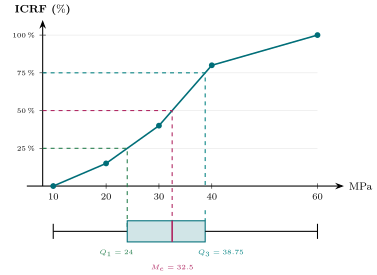
What the exercise establishes. Two distinct quantiles (here and ) can belong to the same class when its frequency is high: linear interpolation then assigns them distinct values, proportional to how far they exceed .
Similar exercises
- Mode, weighted mean and finding a missing frequency solved
- Linearity of the mean and mean of a union of subpopulations solved
- Median, quartiles, range and interquartile range of a discrete series, and robustness solved
- Calculating the variance from the definition and with the Koenig–Huygens formula solved
- Effect of an affine change of variable on the mean, the variance and the standard deviation solved
The course of the chapter · All the exercises of the chapter