Mathematics (Grade 10, Lebanon) · Chapter 3 · Tutorial exercise
Problem: Checking the regularity of two mineral-water bottling lines in Sannine
Statistical measures · C. Variance, standard deviation, Koenig–Huygens formula and affine change · level 3 (hard)
Statement
In a spring mineral-water bottling plant in Sannine, two automatic lines and fill bottles whose nominal capacity is . To check their precision and their regularity, bottles are taken at random from line and bottles from line , and the exact volume of water (in ) is measured:
1) State the modal class of each line. Setting , calculate the mean and the mean . What do we notice because of the symmetry of the frequencies?
2) Draw up the rows of increasing cumulative frequencies of lines and , then calculate by linear interpolation the median , the quartiles and the interquartile range of each of the two lines.
3) Calculate the variance and the standard deviations and of the two lines using the coded variable .
4) Which of the two lines is the more regular? Justify the answer both with the interquartile ranges and with the standard deviations.
5) The plant's specifications require a bottle to contain between and (). What is the percentage of compliant bottles on line and on line ?
Solution
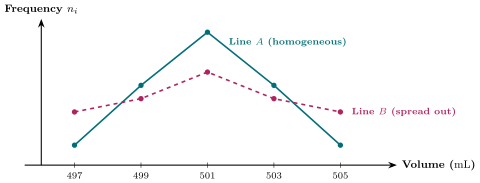
Strategy. Since the two distributions are symmetric about the central class with midpoint , they have exactly the same mean and the same median : only the measures of dispersion ( and ) can tell their regularity apart.
1) Modal class and mean of the two lines. Since the five classes have the same width , the modal class of each of the two lines is (largest frequencies and ). With , the symmetry of the frequencies ( and ) immediately gives for as well as for , hence and:
2) Medians, quartiles and interquartile ranges.
- Line : the ICFs at the boundaries are .
- Rank in : .
- Rank in (): .
- Rank in (): .
- Interquartile range: .
- Line : the ICFs at the boundaries are .
- Rank in : .
- Rank in (): .
- Rank in (): .
- Interquartile range: .
3) Variances and standard deviations. Since , we have and :
- Line : hence and .
- Line : hence and .
4) Comparing the regularity. With an identical central position (), line is clearly more regular (more homogeneous) than line , because both of its measures of dispersion are strictly smaller: and .
5) Proportion of compliant bottles (). This interval groups the three central classes , and :
- on line : of compliant bottles;
- on line : of compliant bottles.
What the exercise establishes. Two statistical series can have exactly the same mean and the same median while having opposite industrial qualities: only a joint analysis of position and dispersion ( or ) can characterize the homogeneity of a production.
Similar exercises
- Linearity of the mean and mean of a union of subpopulations solved
- Median, quartiles, range and interquartile range of a discrete series, and robustness solved
- Modal class, mean, median and quartiles of a series grouped into classes solved
- Calculating the variance from the definition and with the Koenig–Huygens formula solved
- Effect of an affine change of variable on the mean, the variance and the standard deviation solved
The course of the chapter · All the exercises of the chapter