Mathematics (Grade 10, Lebanon) · Chapter 6 · Tutorial exercise
Problem: Hydraulic sizing of an irrigation canal
Order on ℝ · C. Intervals of ℝ and synthesis problem · level 3 (hard)
Statement
To carry water from a mountain spring to farming terraces, an engineer studies the sizing of an open irrigation canal.
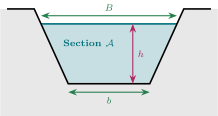
1) Bounding the wetted cross-section and the flow rate of a trapezoidal profile. In a first stretch with a trapezoidal cross-section, the bottom width (in ), the top width (at the surface) (in ) and the water depth (in ) are known through the following double inequalities:
- a) Given that the area of the trapezoidal wetted cross-section is , find bounds for (in ) and calculate the width of this double inequality.
- b) The mean flow velocity of the water (in ) satisfies . Bound the volume flow rate (in ).
2) Optimizing the wetted perimeter of a rectangular profile. In a second masonry stretch with a rectangular cross-section of width (in ) and water depth (in ), a fixed wetted cross-sectional area is imposed, that is . To reduce friction losses on the walls, we try to minimize the wetted perimeter (formed by the bottom of width and the two vertical walls of height ):
- a) Prove that, for every real number , we have: Deduce that for every , and state the dimensions of the rectangular canal that minimize the wetted perimeter (what do we notice about the ratio ?).
- b) Let and be two widths such that . Prove that: then study the sign of this difference and compare and . Deduce an exact double inequality for when the width belongs to the interval .
3) Operating ranges of the control gates. Downstream of the canal, two automatic gates react to the water depth (in ):
- the main supply gate is open when ;
- the safety relief gate opens when .
Find the sets and , and interpret each of them concretely for the hydraulic operation of the structure.
Solution
Strategy. This problem uses in turn the operations on double inequalities for positive geometric quantities, the study of the sign of a difference by writing it as a perfect square then by factoring in order to minimize and bound the wetted perimeter, and finally the intersection and the union of intervals to analyze a system with two thresholds.
1) Bounding the wetted cross-section and the flow rate .
- a) Let us add side by side the double inequalities for and : Dividing by , we obtain: Since all the bounds are positive, let us multiply side by side with : The width of this double inequality is .
- b) Multiplying side by side the positive double inequalities and , with and :
2) Minimizing and bounding the wetted perimeter .
- a) For every , let us reduce to the denominator : Since and , we have , so for every . The equality holds if and only if , that is , which gives a water depth . The wetted perimeter is therefore minimal (equal to ) when the width is twice the water depth ().
- b) For , let us calculate the difference: Now ; moreover, since and , we have , so and . Thus , that is . Consequently, when satisfies , the quantity remains between and :
3) Operating intervals of the two gates.
- Intersection: . It is the range of water depths (between and included) for which both gates are open simultaneously.
- Union: since and overlap, . It is the range of water depths for which at least one of the two gates is open.
What the exercise establishes. Studying the sign of through the appearance of a perfect square makes it possible to prove a minimum rigorously without any advanced tool of analysis, whereas factoring makes it possible to bound exactly an expression in which appears twice.
Similar exercises
- Comparing irrational expressions by squaring and taking the reciprocal solved
- Comparing , , , and according to the position relative to solved
- Bounding sums, differences, products and quotients with negative bounds solved
- Optimizing a double inequality by rewriting a homographic expression solved
- Representation on the graduated line, intersections and unions of intervals solved
The course of the chapter · All the exercises of the chapter