Mathematics (Grade 10, Lebanon) · Chapter 6 · Tutorial exercise
Representation on the graduated line, intersections and unions of intervals
Order on ℝ · C. Intervals of ℝ and synthesis problem · level 2
Statement
1) Consider the three intervals , and .
- a) Represent , and on the same graduated line.
- b) Find , , , and .
2) Express as an interval the set of real numbers satisfying simultaneously the two inequalities:
3) Let be a real parameter. Consider the bounded intervals and .
- a) What is the width of the interval ? Does it depend on ?
- b) Find the values of for which the intersection is reduced to a singleton.
- c) Find the set of values of for which the interval is entirely included in ().
Solution
Strategy. We visualize the intervals on the graduated line, paying particular attention to the direction of the brackets at the boundary endpoints: a point belongs to if it is covered by both segments (“and”), and to if it is covered by at least one of the two (“or”).
1) Intersections and unions of , and .
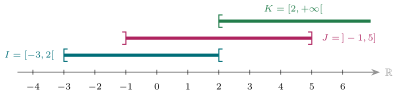
- and : the real numbers common to and are those strictly between (excluded from ) and (excluded from ), that is . Since and overlap, their union goes from included to included: .
- and : the endpoint is excluded from and every element of is greater than or equal to , so . On the other hand, since , the two intervals join exactly at without a gap: .
- : the real numbers satisfying both and satisfy , hence .
2) Translating a system of inequalities. Let us solve each inequality separately:
- ;
- .
The word “and” is translated by the intersection of the two intervals:
3) Parametrized interval and fixed interval .
- a) The width of is : it is constant and independent of (varying translates a segment of length along the real line).
- b) Two closed intervals and have an intersection reduced to a single point if and only if the right endpoint of the first coincides with the left endpoint of the second, or the left endpoint of the first with the right endpoint of the second:
- First case: , which gives .
- Second case: , which gives .
The two required values are therefore and .
- c) The interval is included in if and only if its lower endpoint is greater than or equal to and its upper endpoint is less than or equal to :
What the exercise establishes. A system of two conditions linked by “and” always corresponds to an intersection of intervals . At junction endpoints such as between and , it is enough that the point belongs to one of the two intervals for the union to be in one piece.
Similar exercises
- Comparing irrational expressions by squaring and taking the reciprocal solved
- Comparing , , , and according to the position relative to solved
- Bounding sums, differences, products and quotients with negative bounds solved
- Optimizing a double inequality by rewriting a homographic expression solved
- Problem: Hydraulic sizing of an irrigation canal solved
The course of the chapter · All the exercises of the chapter