Mathematics (Grade 11 Humanities, Lebanon) · Chapter 8 · Tutorial exercise
Study of a homographic function
Studying the variations of functions · B. Homographic functions · level 2
Statement
Let .
1) Give the excluded value and the domain of definition of .
2) Calculate the limit of at and at . Which asymptote can be deduced?
3) Calculate the limit of at , from the right then from the left. Which asymptote can be deduced?
4) Calculate and give its sign.
5) Draw up the table of variations of .
6) Find the points of intersection of the curve with the axes.
7) Calculate and , then check that the midpoint of the points and is the point of intersection of the asymptotes.
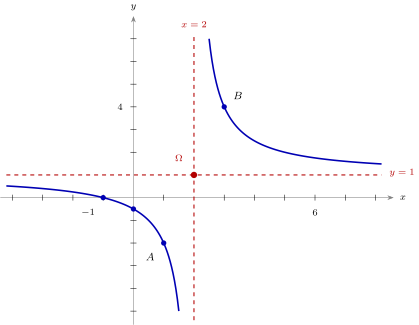
8) Draw the asymptotes, then the curve of .
Solution
1) for : the excluded value is . The domain is .
2) At infinity, the limit is that of the quotient of the highest-degree terms, : The line with equation is a horizontal asymptote.
3) The numerator tends to , positive. The denominator is positive to the right of , negative to the left: The line with equation is a vertical asymptote.
4) With and , we have and : The numerator is negative and the denominator is a square: for every .
5) The function is decreasing on each of the two intervals.
6) : point on the -axis. The numerator is zero for : point on the -axis.
7) and . The midpoint of and has coordinates It is indeed the point where the asymptotes and intersect: the center of symmetry of the curve.
8) We first draw the two asymptotes as dashed lines, then we plot the points found and draw the two branches.
Similar exercises
- Complete study and drawing of a parabola solved
- Reading a parabola solved
- Position of a parabola and a line solved
- Reading a hyperbola solved
- Problem: the jam workshop solved
The course of the chapter · All the exercises of the chapter