Mathematics (Grade 11, Lebanon) · Chapter 1 · Tutorial exercise
Problem: Parabolic arch of a bridge and navigation clearance
Second-degree equations · D. Equations with a parameter and synthesis problem · level 3 (hard)
Statement
The arch of a bridge spanning a river has the shape of an arc of a parabola . In the vertical plane of the arch, equipped with an orthonormal coordinate system (unit: the meter) in which the axis represents the surface of the water and the axis the vertical axis of symmetry of the bridge, the height of the vault above the water at abscissa is modeled by:
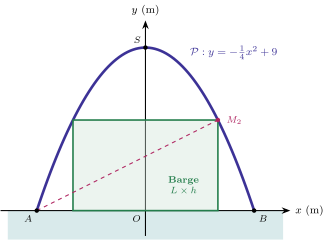
1) Determine the maximum height of the arch above the water (at the vertex ) as well as the total width of the river at water level between the two feet and of the arch.
2) A river barge with a rectangular cross-section, of width and of height above the waterline, passes under the bridge keeping its course centered on the axis .
- a) Show that the barge touches the vault at its two upper corners if and only if .
- b) What is the maximum width of a barge whose height above the water is ?
- c) We want a barge whose emerged perimeter is and which just grazes the vault to pass. Form the second-degree equation satisfied by , solve it and determine the possible dimensions of the barge.
3) A spotlight installed at the left foot of the arch emits a straight light beam along the line with equation . Determine the coordinates of the second point of impact of the beam on the vault , as well as the coordinates of the midpoint of .
4) More generally, for every line with slope and equation () that cuts the parabola at two points and :
- a) Write the second-degree equation satisfied by and , and determine the value of for which the line is tangent to the arch (a single point of contact , whose coordinates are to be given).
- b) When , use the sum of the roots to show that the abscissa of the midpoint of the chord is independent of , and deduce on which fixed line the point moves when varies.
Solution
Strategy. This problem successively uses solving (feet of the arch), setting up the geometric equation of a rectangle inscribed under the parabola, the equation giving the abscissas of intersection of a parabola and a line, the tangency condition , and the geometric interpretation of the half-sum of the roots .
1) Height at the crown and span of the arch. For , we have : the vertex is at a maximum height above the water. The feet and of the arch at water level () have as abscissas the solutions of: Thus and , and the total width of the arch at water level is .
2) Passage of a rectangular barge.
- a) Since the barge of width is centered on , its side walls have abscissas and (with ), and its upper corners have coordinates . They belong to the parabola if and only if:
- b) For , the equation gives , that is (since ) a maximum width .
- c) The condition is equivalent to , that is (with ). Replacing by in the relation , we obtain: This equation has a double root , hence . The barge is therefore wide and high.
3) Intersection of the light beam with the arch. The abscissas of the points of intersection of and are the solutions of: Since (abscissa of ) is a known root, the product of the roots immediately gives . The corresponding ordinate is , that is . The midpoint of the segment has coordinates:
4) Family of parallel lines and locus of the midpoints of the chords.
- a) The abscissas of intersection of and satisfy: The reduced discriminant of this second-degree equation is: The line is tangent to the parabola if and only if the equation of the abscissas has a double root, that is, if and only if . The abscissa of the point of contact is then the double root , and its ordinate is , that is .
- b) For every , we have and the line cuts at two distinct points and . By Vieta's formulas applied to the equation , the sum of the roots is , independently of . The abscissa of the midpoint of is therefore constant: When ranges over , the midpoint of the parallel chords with slope describes the vertical ray with equation located below the point of tangency .
What the exercise establishes. The intersection of a parabola and a line translates into the second-degree equation : the vanishing of its discriminant characterizes the tangent with slope , while the constancy of the sum proves that the midpoints of all the chords parallel to a given direction lie on the vertical line through the point of contact of the parallel tangent.
Similar exercises
- Symmetric expressions of the roots and a new second-degree equation solved
- Sum-product system and rectangle inscribed in a semicircle solved
- Biquadratic equation and reciprocal equation of degree four solved
- Rational equation and irrational equations solved
- Complete discussion of an equation with a parameter and a relation independent of solved
The course of the chapter · All the exercises of the chapter