Mathematics (Grade 11, Lebanon) · Chapter 1 · Tutorial exercise
Sum-product system and rectangle inscribed in a semicircle
Second-degree equations · B. Sum and product of the roots (Vieta's relations) · level 2
Statement
1) Solve in the system:
2) Let be a semicircle with diameter , where , and with center . A rectangle is inscribed in this semicircle such that and belong to the segment (symmetrically about ) and and belong to the arc of the semicircle. Let be the length of the base of the rectangle and its height (, ).
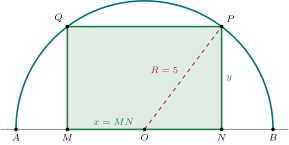
Determine the dimensions and of the rectangle so that its perimeter equals .
Solution
Strategy. In a system that is symmetric in and , we introduce the auxiliary unknowns and : we first determine the possible pairs , then we solve for each pair.
1) Solving the system by the change of variables . Factoring out in the second equation, we notice that . Setting and , the system becomes: The real numbers and have sum and product : they are therefore the two roots of the auxiliary equation . Since , we obtain two cases:
- First case: and . The real numbers and are the solutions of , whose roots are and , which gives the pairs and .
- Second case: and . The real numbers and are the solutions of , whose roots are and , which gives the pairs and .
The solution set of the system in is therefore:
2) Dimensions of the inscribed rectangle. By the symmetry of the figure about the perpendicular bisector of through , the point is the midpoint of , so . In the triangle , right-angled at , the hypotenuse is a radius of the semicircle, that is . The Pythagorean theorem gives: Moreover, the perimeter of is , that is . Let us express (with , so ) and substitute into : Let us calculate the reduced discriminant with : The two solutions of the equation in are: We deduce the corresponding values of :
- if , then (check: );
- if , then (check: ).
There are therefore two inscribed rectangles that answer the question, with dimensions and .
What the exercise establishes. An algebraic system that is invariant under swapping and always reduces to the elementary variables and ; in a geometric problem combining perimeter and the Pythagorean theorem, substitution yields a second-degree equation whose roots are filtered according to the geometric constraints ( and ).
Similar exercises
- Canonical form, reduced discriminant and radical coefficients solved
- Symmetric expressions of the roots and a new second-degree equation solved
- Biquadratic equation and reciprocal equation of degree four solved
- Rational equation and irrational equations solved
- Complete discussion of an equation with a parameter and a relation independent of solved
The course of the chapter · All the exercises of the chapter