Mathematics (Grade 12 General Sciences, Lebanon) · Chapter 16 · Tutorial exercise
Analytic computation of the cross product, Lagrange's identity and direct orthonormal basis
Cross product and scalar triple product in space · A. Cross product in oriented space and analytic components · level 1 (application)
Statement
In space referred to the direct orthonormal coordinate system , consider the vectors:
- Compute the coordinates of the cross product and check with two dot products that is orthogonal to and to .
- Compute , , and , then check Lagrange's identity: Deduce and .
- From , and , construct three unit vectors , , forming a direct orthonormal basis of space.
Solution
- Coordinates of and check. By the analytic expression of the cross product in the direct orthonormal basis : Orthogonality check: The vector is indeed orthogonal to both and .
- Norms, dot product, Lagrange's identity and geometric angle. We compute in turn: We then check that: Denoting , we deduce:
- Constructing a direct orthonormal basis . Caution: the vectors and are not orthogonal, since . We therefore complete the basis from and , which are orthogonal, by setting: The vectors and are unit vectors and orthogonal (). For to be a direct orthonormal basis, it is necessary and sufficient to set . Now: with norm , which gives the third unit vector:
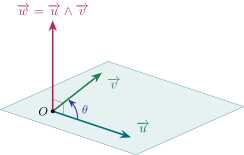
What the exercise establishes. Computing a cross product while systematically checking the result with the two dot products and , using Lagrange's identity to obtain , and completing two orthogonal unit vectors into a direct orthonormal basis by a cross product.
Similar exercises
- Algebraic properties of the cross product and characterization of collinearity solved
- Normal vector, area of a triangle and distance from a point to a line solved
- Level sets and sets of points defined by a cross product solved
- determinant, orientation of a basis and coplanarity of four points solved
- Volume of a parallelepiped, volume of a tetrahedron and height from a vertex solved
The course of the chapter · All the exercises of the chapter