Mathematics (Grade 12 General Sciences, Lebanon) · Chapter 16 · Tutorial exercise
Volume of a parallelepiped, volume of a tetrahedron and height from a vertex
Cross product and scalar triple product in space · D. Volumes of a parallelepiped and of a tetrahedron, and final problem · level 2
Statement
In space equipped with the direct orthonormal coordinate system , consider the four points:
- Compute the coordinates of the vector and deduce the area of the triangle . What is special about the triangle ?
- Compute the scalar triple product and justify that the points , , , form a nondegenerate tetrahedron.
- Deduce the volume of the parallelepiped built on , , as well as the volume of the tetrahedron .
- Compute the area of the face and deduce the length of the height from the vertex to the plane .
Solution
- Cross product and area of . We have and . Since : The area of the triangle is therefore: Moreover, , and : the triangle has a right angle at (with hypotenuse ).
- Scalar triple product . The vector has coordinates . Thus: Since the scalar triple product is nonzero, the four points , , , are not coplanar and form a nondegenerate tetrahedron .
- Volumes of the parallelepiped and of the tetrahedron.
- The volume of the parallelepiped built on , , is:
- The volume of the tetrahedron is one sixth of that of the parallelepiped:
- Area of the face and height from . Let us compute the coordinates of and , then their cross product: The norm of this cross product is . The area of the face is therefore: Now the volume of the tetrahedron can also be expressed by taking the face as the base and as the height:
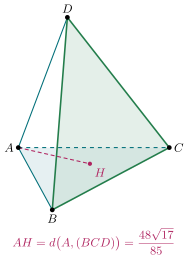
What the exercise establishes. Using the two expressions for the volume of a tetrahedron, , to compute the height from any vertex to the opposite face.
Similar exercises
- Algebraic properties of the cross product and characterization of collinearity solved
- Normal vector, area of a triangle and distance from a point to a line solved
- Level sets and sets of points defined by a cross product solved
- determinant, orientation of a basis and coplanarity of four points solved
- Problem: Vector geometry of a solar greenhouse module in the Bekaa solved
The course of the chapter · All the exercises of the chapter