Mathematics (Grade 12 General Sciences, Lebanon) · Chapter 18 · Tutorial exercise
Relative positions of two planes, perpendicular planes and line of intersection
Parallelism, orthogonality and distances in space · A. Relative positions of two planes and of a line and a plane · level 1 (application)
Statement
In space equipped with the direct orthonormal coordinate system , consider the four planes with Cartesian equations:
- Study the relative position of the planes and .
- Show that the planes and are perpendicular, then find a parametric representation of their line of intersection .
- Determine a Cartesian equation of the unique plane passing through the point and perpendicular to both planes and .
Solution
- Relative position of and . The respective normal vectors are and . We observe that : the normal vectors are collinear, so the planes and are parallel. Now, multiplying the equation of by , we obtain , and since , the two equations are not proportional. The planes and are therefore strictly parallel ().
- Perpendicularity and line of intersection .
- The normal vector of is . The dot product of the two normal vectors is: Since the normal vectors are orthogonal, the planes and are perpendicular (), and therefore intersect in a line .
- To parametrize , note that and appear only through their sum : Subtracting twice the second equation from the first, we obtain , that is, : the -coordinate is constant along , and cannot serve as the parameter. Let us take (): the second equation gives . A parametric representation of is therefore: with direction vector (and we do check that ).
- Plane passing through and perpendicular to and . A plane is perpendicular to and to if and only if its normal vector is orthogonal both to and to . We can therefore choose: Since passes through , its Cartesian equation is:
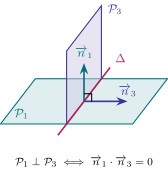
What the exercise establishes. Systematically testing the collinearity () and the orthogonality () of the normal vectors of two planes, and remembering that the normal vector of a plane perpendicular to two intersecting planes points along their line of intersection, .
Similar exercises
- Relative positions of a line and a plane solved
- Coplanar or non-coplanar lines, orthogonal and perpendicular lines solved
- Orthogonal projection, reflection of a point in a plane and distance between parallel planes solved
- Locus of points equidistant from two intersecting planes and sphere tangent to a plane solved
- Orthogonal projection and distance from a point to a line by two methods solved
The course of the chapter · All the exercises of the chapter