Mathematics (Grade 12 General Sciences, Lebanon) · Chapter 19 · Tutorial exercise
Cyclic convex quadrilateral and computing a diagonal with Al-Kashi
Metric relations and areas in a triangle · B. Trigonometric relations, cyclic quadrilaterals and orthic triangle · level 2
Statement
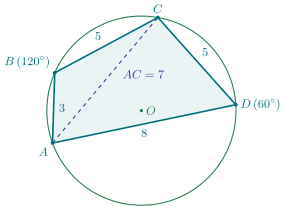
Let be a convex quadrilateral inscribed in a circle of radius , whose consecutive sides measure , , and .
1) Justify that the opposite angles and are supplementary, and deduce that and .
2) By expressing in two ways using Al-Kashi's theorem in the triangles and , compute the exact value of , the measure in degrees of the angle and the exact length of the diagonal .
3) Deduce the radius of the circumscribed circle as well as the total area of the quadrilateral .
Solution
The strategy. In a convex quadrilateral inscribed in a circle, two opposite angles are supplementary, so their cosines are opposites. Expressing the square of the same diagonal by Al-Kashi's theorem in the two triangles it separates then gives a first-degree equation that determines both the cosine of the angle and the length of the diagonal.
1) Opposite angles of a cyclic quadrilateral. In the convex quadrilateral inscribed in , the opposite inscribed angles and intercept two arcs that make up the whole circle: their measures therefore add up to (). By the formulas for related angles:
2) Computing and the diagonal . Let us apply Al-Kashi's theorem in the triangle , then in the triangle : Equating these two expressions for , we obtain: Since , we deduce and . Substituting into the first expression for :
3) Circumradius and area of the quadrilateral. The circle is the circle circumscribed about the triangle . By the law of sines in : The area of the convex quadrilateral is the sum of the areas of the triangles and :
What the exercise establishes. The method of applying Al-Kashi twice to one diagonal makes it possible to solve any cyclic quadrilateral whose four consecutive sides are known.
Similar exercises
- Complete metric study of the triangle and the median theorem solved
- Characterization of triangles with perpendicular medians solved
- Trigonometric characterizations of the nature of a triangle solved
- Orthic triangle of an acute triangle: sides, area and perimeter solved
- Problem: Euler's formula () and the South Pole theorem solved
The course of the chapter · All the exercises of the chapter