Mathematics (Grade 12 General Sciences, Lebanon) · Chapter 19 · Tutorial exercise
Problem: Euler's formula () and the South Pole theorem
Metric relations and areas in a triangle · B. Trigonometric relations, cyclic quadrilaterals and orthic triangle · level 3 (hard)
Statement
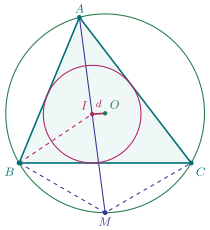
Let be a triangle with sides , , , semiperimeter , area , circumscribed circle and inscribed circle . The interior bisector of the angle (that is, the line ) meets the circumscribed circle again at a point distinct from .
Part A — Property of the midpoint of the arc (South Pole theorem, also called the trillium theorem).
- 1) Using the inscribed angle theorem in the circle , express the measures of the angles and in terms of .
- 2) Using the fact that is the bisector of the angle and that is an exterior angle of the triangle , express the angles and in terms of and .
- 3) Deduce that the triangle is isosceles with apex (), then prove that:
Part B — Euler's relation and Euler's inequality.
- 4) Let be the orthogonal projection of onto the side . Express in terms of the inradius and , then deduce the value of the product:
- 5) Suppose . The line cuts the circle at two diametrically opposite points and (with ). Express the product in terms of and the distance .
- 6) By comparing the inscribed angles in the triangles and , prove that , then establish Euler's formula: Deduce Euler's inequality and state under what condition on the triangle the equality holds.
Part C — Numerical application.
- 7) In the triangle with sides , and , compute , , and , then deduce the exact value of the distance .
Solution
The strategy. The point where the bisector meets the circumscribed circle again has the striking property of being equidistant from , from and from the incenter (). The law of sines in gives , the right triangle gives , and the equality of the products of the segments of the two chords and intersecting at directly relates to .
Part A — Property of the midpoint of the arc .
1) Inscribed angles and . Since is the interior bisector of the angle , we have . By the inscribed angle theorem in the circumscribed circle :
- the inscribed angles and intercept the same arc , so ;
- the inscribed angles and intercept the same arc , so .
2) Angles of the triangle . Since the point is where the interior bisectors meet, is the bisector of , so . Adding adjacent angles: On the other hand, in the triangle , the exterior angle at the vertex is equal to the sum of the two non-adjacent interior angles:
3) The triangle is isosceles; computing . We have : the triangle is therefore isosceles with apex , hence (and since , we also have ). Applying the law of sines in the triangle inscribed in the circle of radius , the side is opposite the angle , hence:
Part B — Euler's relation and Euler's inequality.
4) Computing and the product . The inscribed circle is tangent to at , so the triangle has a right angle at , with and . Thus: Multiplying by , the factor cancels out:
5) The product on the diameter . The point lies inside the circle , so . The distances from to the endpoints and of the diameter through and are and , hence:
6) Euler's formula and inequality. The chords and intersect at . In the triangles and , the vertical angles and are equal, and the inscribed angles and intercept the same arc , so they are equal. The triangles and have their angles pairwise equal, hence: Combining questions 4 and 5, we obtain Euler's formula: Since and , it follows that , that is, (Euler's inequality), with equality if and only if , that is, when the triangle is equilateral.
Part C — Numerical application.
7) The case of the triangle. The semiperimeter is , with , and . By Heron's formula: We deduce: Euler's formula then gives:
What the exercise establishes. Euler's formula shows that the distance between the circumcenter and the incenter depends only on the two radii and , and that the circumradius of a triangle is always at least equal to the diameter of its inscribed circle.
Similar exercises
- Complete metric study of the triangle and the median theorem solved
- Characterization of triangles with perpendicular medians solved
- Trigonometric characterizations of the nature of a triangle solved
- Cyclic convex quadrilateral and computing a diagonal with Al-Kashi solved
- Orthic triangle of an acute triangle: sides, area and perimeter solved
The course of the chapter · All the exercises of the chapter