Mathematics (Grade 12 General Sciences, Lebanon) · Chapter 20 · Tutorial exercise
Sixth roots of a complex number, factorization and a regular hexagon
Modulus, argument and exponential form of a complex number · B. Going further and geometric configurations · level 2
Statement
Consider in the equation .
1. Write in exponential form and determine the six solutions of in exponential form, then in algebraic form.
2. Group the solutions in pairs of complex conjugates and deduce the factorization of the polynomial as a product of three quadratic trinomials with real coefficients.
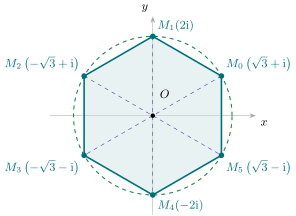
3. Plot the six image points in the complex plane and compute the perimeter and the area of the regular hexagon .
Solution
1. We have . Looking for (), the equation is equivalent to: The six sixth roots of are therefore:
- ;
- ;
- ;
- ;
- ;
- .
2. We immediately observe the three pairs of conjugates: , and . For every complex number , we have . Since , we get:
- ;
- ;
- . The polynomial therefore factors over as:
3. The six points lie on the circle with center and radius , and the central angle between two consecutive vertices is (). Each triangle is therefore equilateral with side .
- The perimeter of the regular hexagon is .
- The area of an equilateral triangle with side is , so the total area of the regular hexagon is:
Similar exercises
- Modulus, conjugate and complex numbers of modulus solved
- Half-angle factorization and sign discussion solved
- Euler linearization, De Moivre's formula and a trigonometric equation solved
- A parametric complex equation and th roots solved
- Problem: The ninth roots of unity and the minimal polynomial of solved
The course of the chapter · All the exercises of the chapter