Mathematics (Grade 12 General Sciences, Lebanon) · Chapter 4 · Tutorial exercise
Complete study of , concavity and comparison of and
Logarithmic functions · C. Studies of logarithmic functions, concavity and a synthesis problem · level 2
Statement
Let be the function defined on by: Let denote its representative curve in an orthonormal coordinate system .
- Determine the limits of at and at , and state the two asymptotes to the curve .
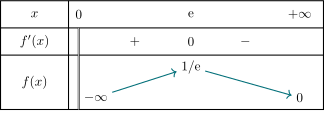
- Compute for every , study its sign and draw up the table of variations of . What is the absolute maximum of on ?
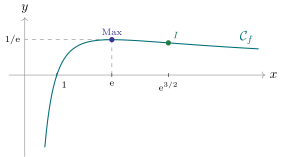
- Compute the second derivative for every , study the convexity of and determine the coordinates of the unique point of inflection of .
- A classic arithmetic application: without a calculator, using the direction of variation of on , compare the numbers and , then prove that the only pair of nonzero natural numbers such that and is the pair .
Solution
1. Limits and asymptotes.
- At : and , so as a product: The -axis is a vertical asymptote to .
- At : by the comparative growth theorem: The -axis is a horizontal asymptote to at .
2. First derivative, variations and maximum. The function is differentiable on as a quotient of two differentiable functions, and for every : Since , the sign of is that of : The function is therefore strictly increasing on and strictly decreasing on . It reaches its absolute maximum at , which equals .
3. Second derivative, convexity and point of inflection. For every , let us differentiate : Since on , the sign of is that of : The function is therefore concave on and convex on , and has a unique point of inflection:
4. Comparing and , and the equation .
- We know that . On the interval , the function is strictly decreasing, so: Since is strictly increasing on , we conclude that .
- For two nonzero natural numbers , the equality is equivalent to . Since is strictly decreasing on , we cannot have . Thus . Now has no other preimage, so . Finally , and since is strictly decreasing on , is the unique solution. The unique pair is indeed ().
What the exercise establishes.
- Turn a comparison of the powers and into a comparison of and through the variations of .
Similar exercises
- Reference limits and comparative growth theorems solved
- Differentiating and computing antiderivatives of the form solved
- The concavity inequality and bounds for solved
- Composite function with a logarithm, parity and oblique asymptote solved
- Synthesis problem: auxiliary function, implicit root and study of a logarithmic curve solved
The course of the chapter · All the exercises of the chapter