Mathematics (Grade 12 General Sciences, Lebanon) · Chapter 4 · Tutorial exercise
Synthesis problem: auxiliary function, implicit root and study of a logarithmic curve
Logarithmic functions · C. Studies of logarithmic functions, concavity and a synthesis problem · level 3 (hard)
Statement
Part A — Study of an auxiliary function. Let be the function defined on by:
- Study the direction of variation of on and state its limits at and at .
- Prove that the equation has a unique solution in , and check that .
- Deduce the sign of on .
Part B — Study of the main function . Consider the function defined on by: Let denote its representative curve in an orthonormal coordinate system with graphical unit .
- Determine the limit of at and interpret the result graphically.
- Determine the limit of at , prove that the line with equation is an oblique asymptote to at , and study the relative position of and on .
- Prove that, for every , we have:
- Deduce the direction of variation of and draw up its complete table of variations.
- Using the relation , prove that: and deduce a bound for .
Solution
Part A — Study of the auxiliary function .
1. Direction of variation and limits of . On , the function is differentiable as a sum of differentiable functions, and for every : (We may also note that and are both strictly increasing on .) The function is therefore continuous and strictly increasing on . At the endpoints:
- At : and , so .
- At : and , so .
2. Existence, uniqueness and bounds for . Since is continuous and strictly increasing on from to , by the bijection theorem the equation has a unique solution . Let us compute and : Since is strictly increasing, we obtain (in fact ).
3. Sign of on . Since is strictly increasing on :
- for every , ;
- ;
- for every , .
Part B — Study of the main function .
1. Limit at and vertical asymptote. As , we have , so . Since , by product and by sum with : The -axis is a vertical asymptote to the curve .
2. Limit at , oblique asymptote and relative position. For every , we have: Now and, by comparative growth, . We deduce on the one hand that , which proves that the line is an oblique asymptote to at , and on the other hand that . Let us study the sign of the difference on : since , its sign is that of :
- On , the curve lies strictly above ;
- At , the curve crosses its asymptote at the point ;
- On , the curve lies strictly below .
3. Computing . The function is differentiable on and, for every , differentiating the quotient :
4. Variations of . Since , the sign of is that of , studied in Part A:
- on : is strictly decreasing on ;
- ;
- on : is strictly increasing on .
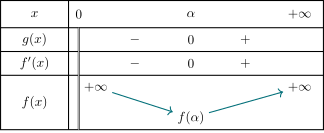
5. Algebraic expression and bounds for the minimum . By definition of , we have , that is, , from which we get: Substituting this relation into the expression of : The function is strictly increasing on (a sum of strictly increasing functions). With the bound , we obtain: The minimum of on is therefore about : it is positive.
What the exercise establishes.
- Eliminate from the expression of using the implicit equation , which turns a transcendental value into a rational expression in that is easy to bound.
Similar exercises
- Reference limits and comparative growth theorems solved
- Differentiating and computing antiderivatives of the form solved
- Complete study of , concavity and comparison of and solved
- The concavity inequality and bounds for solved
- Composite function with a logarithm, parity and oblique asymptote solved
The course of the chapter · All the exercises of the chapter