Mathematics (Grade 12 General Sciences, Lebanon) · Chapter 5 · Tutorial exercise
Synthesis problem: study of an exponential function, common tangent and implicitly defined root
Exponential and power functions · C. Logistic function, inverse function and synthesis problem · level 3 (hard)
Statement
Consider the function defined on by: Let denote its representative curve in an orthonormal coordinate system .
Part A — Study of an auxiliary function. Let be the function defined on by:
- Compute for every , study its sign and determine the limits of at and at .
- Draw up the table of variations of on , compute and deduce the sign of according to the values of .
Part B — Study of the function and of the curve .
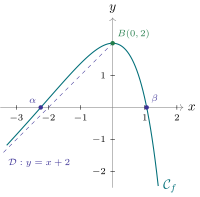
- Determine the limit of at and prove that the line with equation is an oblique asymptote to at . Study the relative position of and on .
- Determine the limit of at and study the infinite branch of at .
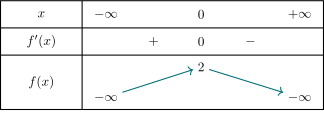
- Check that for every , , and draw up the complete table of variations of .
- Prove that the equation has exactly two real solutions and such that , and check that:
- Show that and deduce the rational expression in of the slope of the tangent to at the point with abscissa .
Solution
Part A — Study of the auxiliary function .
1. Derivative and limits of . The function is differentiable on and, for every , differentiating the product : Since on , the sign of is that of :
- on ;
- ;
- on .
At the endpoints of :
- At : (comparative growth) and , so .
- At : , so .
2. Table of variations and sign of . The function increases on from to , then strictly decreases on from to . Now we notice that:
- On , since and increases, we have .
- On , is strictly decreasing and vanishes at , so on and on . In summary:
- for every ;
- ;
- for every .
(Note that also shows that the curve has a unique point of inflection, with abscissa and ordinate .)
Part B — Study of the main function .
1. Limit at , asymptote and relative position. For every , we have: By comparative growth at , , hence:
- on the one hand : the line is an oblique asymptote to at ;
- on the other hand .
The sign of is that of (since ):
- on , : lies strictly above ;
- at , and intersect at the point ;
- on , : lies strictly below .
2. Limit and infinite branch at . For , let us factor out : Since , the parenthesis tends to , and as a product with : The curve has at a parabolic branch in the direction of the -axis .
3. Derivative and table of variations of . For every , . By the study of the sign of in Part A, is strictly increasing on and strictly decreasing on , with an absolute maximum :
4. Existence, uniqueness and bounds for the two roots and . Let us apply the bijection theorem on each of the two intervals on which is strictly monotonic:
- On , is continuous and strictly increasing from to . Since , the equation has a unique solution in . Moreover: Since is strictly increasing on , we obtain .
- On , is continuous and strictly decreasing from to . Since , the equation has a unique solution in (and since ). Moreover: Since is strictly decreasing on , we obtain (in fact ). Thus the equation has exactly two solutions, .
5. Rational expression of . By definition of , we have , that is, . Since , we get: Substituting this expression of into eliminates the exponential function:
What the exercise establishes.
- Use simultaneously an auxiliary function whose extremum at reveals the point of inflection of and whose obvious zero at gives the sign of without having to solve a transcendental equation.
Similar exercises
- Comparative growth, reference limits and indeterminate forms solved
- Differentiation, antiderivatives of and identification of an antiderivative of solved
- The Gaussian bell curve: parity, convexity and points of inflection solved
- The logistic (sigmoid) function, center of symmetry and inverse bijection solved
- Tangents to the exponential curve through the origin and the convexity inequality solved
The course of the chapter · All the exercises of the chapter