Mathematics (Grade 12 General Sciences, Lebanon) · Chapter 5 · Tutorial exercise
The Gaussian bell curve: parity, convexity and points of inflection
Exponential and power functions · B. Differentiating , antiderivatives of , convexity and reference functions · level 2
Statement
Consider the function defined on by: Let denote its representative curve in an orthonormal coordinate system .
- Study the parity of and determine its limits at and at .
- Compute for every , study its sign and draw up the table of variations of .
- Prove that, for every , the second derivative of is given by:
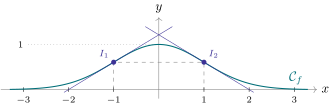
- Study the convexity of on , determine the coordinates of the two points of inflection and of , determine the equations of the tangents at and , then draw the curve .
Solution
1. Parity and limits at the endpoints. For every , : the function is even, and its curve is symmetric about the -axis. As , we have . Since , by composition: The -axis is a horizontal asymptote to at and at .
2. First derivative and variations. By the formula with and , for every : Since on , the sign of is that of : is strictly increasing on and strictly decreasing on , with an absolute maximum .
3. Second derivative. Differentiating the product on :
4. Convexity, points of inflection and graph. Since , the sign of is that of :
- On and on , : the function is convex.
- On , : the function is concave.
- The two points of inflection of the bell curve are: At these points, the derivatives are and , hence the tangents at the points of inflection:
What the exercise establishes.
- Remember that the Gaussian curve , ubiquitous in probability and statistics, changes concavity exactly at the abscissas and .
Similar exercises
- Equations, inequalities and systems in : change of variable and positivity solved
- Comparative growth, reference limits and indeterminate forms solved
- Differentiation, antiderivatives of and identification of an antiderivative of solved
- The logistic (sigmoid) function, center of symmetry and inverse bijection solved
- Tangents to the exponential curve through the origin and the convexity inequality solved
The course of the chapter · All the exercises of the chapter