Mathematics (Grade 12 Sociology and Economics, Lebanon) · Chapter 9 · Tutorial exercise
Depreciation of equipment and equilibrium of supply and demand
Economic models and financial mathematics · B. Functions of economics and the social sciences · level 2
Statement
This exercise has two independent parts.
Part A — Comparing straight-line depreciation and declining-balance depreciation. At time , a printing company acquires a digital press with an initial value ~m.u.
- First method: straight-line depreciation over ~years. a) Calculate the constant annual depreciation and express the net book value of the press after ~years (). b) After how many years is the residual value equal to ~m.u.?
- Second method: depreciation at a constant declining rate per year. Let denote the residual value of the press after ~years (), with . a) Express in terms of and calculate to the nearest unit. b) Using the natural logarithm, determine from which whole year on the residual value becomes strictly less than ~m.u.
Part B — Supply and demand functions on a market. On the market for a handcrafted product, when the unit price is (in m.u.), the demand function and the supply function (expressed in hundreds of units) are modeled by:
- Justify by calculating the derivatives the direction of variation of the demand and of the supply on .
- Determine the equilibrium price and the equilibrium quantity of the market. Give the total receipts of the producers at equilibrium.
Solution
Part A.
- a) With straight-line depreciation over ~years, the constant annual depreciation is: The sequence is arithmetic with first term and common difference , so for every integer : b) We solve ~years.
- a) An annual loss of multiplies the value by . The sequence is geometric with common ratio , hence: For , we obtain ~m.u. b) We solve the inequality for : Since , we have . Dividing by reverses the direction of the inequality: The residual value therefore falls below the threshold of ~m.u. from ~years on.
Part B.
- For every , , so the demand is strictly decreasing with respect to the price. Similarly, , so the supply is strictly increasing.
- The equilibrium price is a solution of the equation : Since is positive, the unique equilibrium price is: The corresponding equilibrium quantity is ~hundred units (that is, about ~units). The total receipts at equilibrium are ~m.u.
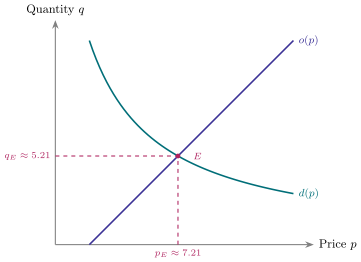
What the exercise establishes. Contrasting the arithmetic decrease of straight-line depreciation with the geometric decrease of declining-balance depreciation (reversing the direction of the inequality when dividing by ), and determining the equilibrium point of a market analytically.
Similar exercises
- Studying a homographic function, tangent line and graphical solution solved
- Graphical reading, identifying parameters and a word problem solved
- Total cost, minimum average cost, maximum profit and elasticity of demand solved
- Choosing between simple and compound interest, equivalent rate and investment period solved
- Building up savings and repaying a loan by constant annuities solved
The course of the chapter · All the exercises of the chapter