Mathematics (Grade 12 Sociology and Economics, Lebanon) · Chapter 9 · Tutorial exercise
Studying a homographic function, tangent line and graphical solution
Economic models and financial mathematics · A. Rational functions, graphical reading and word problems · level 1 (application)
Statement
Let be the function defined on by: Let denote its graph in an orthonormal coordinate system .
- Check that, for every real number , we have .
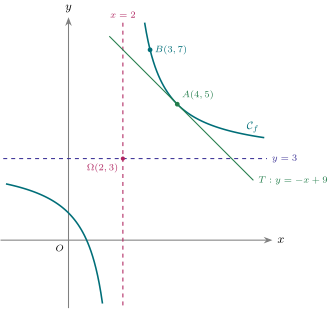
- Determine the limits of at the endpoints of its domain of definition and give the equations of the vertical and horizontal asymptotes to the curve , as well as the coordinates of their point of intersection .
- Calculate the derivative on each of the intervals and , then draw the complete variation table of .
- Determine the slope-intercept equation of the tangent line to the curve at the point with abscissa .
- Solve algebraically, then interpret graphically on the interval : a) the equation ; b) the inequality .
Solution
- Canonical decomposition. For every real number , putting everything over a common denominator:
- Limits at the endpoints of and asymptotes.
- At and at : since and , we obtain: The line with equation is therefore a horizontal asymptote to at and at .
- At and at : we have and , while the numerator is strictly positive. By quotient: The line with equation is therefore a vertical asymptote to .
- The two asymptotes intersect at the point , which is the center of symmetry of the hyperbola .
- Derivative and variations. The homographic function is differentiable on and on . Differentiating the expression : For every , , so . The function is strictly decreasing on (where it decreases from to ) and strictly decreasing on (where it decreases from to ).
- Equation of the tangent line at . We calculate the ordinate and the derivative at : The tangent line at the point has equation:
- Algebraic solutions and graphical interpretation on . a) For : Graphically, the horizontal line with equation intersects the curve at a single point, with abscissa , namely . b) On the interval , we have . Multiplying both sides of the inequality by the strictly positive real number , the direction of the inequality is preserved: The quadratic has discriminant and roots: On , since , the quadratic is nonnegative if and only if . The solution set on is therefore: Graphically, on , the branch of the hyperbola lies below the line with equation from the abscissa on.
What the exercise establishes. Putting a homographic function in the canonical form to read its two asymptotes and directly, calculating its derivative without sign errors, determining the equation of a tangent line, and reducing a rational inequality, on an interval where the denominator keeps a constant sign, to the study of the sign of a quadratic.
Similar exercises
- Graphical reading, identifying parameters and a word problem solved
- Depreciation of equipment and equilibrium of supply and demand solved
- Total cost, minimum average cost, maximum profit and elasticity of demand solved
- Choosing between simple and compound interest, equivalent rate and investment period solved
- Building up savings and repaying a loan by constant annuities solved
The course of the chapter · All the exercises of the chapter