Physics (Grade 10, Lebanon) · Chapter 10 · Tutorial exercise
System of two solids coupled by a string and a pulley on an inclined plane
Newton's laws · B. Newton's second law · level 3 (hard)
Statement
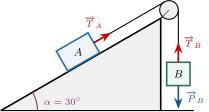
A solid of mass is placed on a plane inclined at an angle to the horizontal (). It is connected by an inextensible string of negligible mass, which passes without friction in the groove of a pulley of negligible mass fixed at the top of the inclined plane, to a second solid of mass hanging vertically in the air. At first, all friction on the inclined plane is neglected.
- By comparing the weight of the hanging solid and the tangential component of the weight of along the inclined plane, determine in which direction the system starts to move when it is released without initial velocity.
- Since the string is inextensible and of negligible mass, when descends a distance , the solid goes up the inclined plane the same distance , so that the two solids have at each instant the same magnitude of acceleration and the tension of the string has the same magnitude at both ends. a) Apply Newton's second law to the solid and project it onto an axis parallel to the inclined plane and oriented up the slope. b) Apply Newton's second law to the solid and project it onto a vertical axis oriented downward. c) By adding the two equations obtained, side by side, to eliminate the unknown , establish the literal expression of the acceleration then calculate its numerical value and that of the tension of the string.
- We now take into account a constant friction force of magnitude exerted by the inclined plane on the solid . Recalculate the acceleration of the system and the new tension of the string.
Solution
- Let us calculate the two opposing driving forces: Since (), the solid wins: descends vertically while goes up the inclined plane.
- Let us study each of the two solids separately in the Galilean terrestrial frame of reference:
- a) For the solid : subjected to , and (directed up the plane). Projecting onto the axis oriented up the plane (direction of the motion of ):
- b) For the solid : subjected to its weight (downward) and to the tension of the string (upward). Projecting onto the vertical axis oriented downward (direction of the motion of ):
- c) Solving the system: let us add and side by side; the tension cancels: Numerical application: Substituting into equation (or ), we obtain the tension of the string: (We notice that : we must indeed have to make accelerate upward, and for to accelerate downward!)
- In the presence of friction () on the solid going up, the force is directed down the inclined plane. Equation becomes , while equation for remains . Adding side by side: The new tension of the string is then:
What the exercise establishes: Master the method for studying systems coupled by an inextensible string: isolate each body, orient each axis in the actual direction of the motion and add the projected equations to eliminate the tension .
Similar exercises
- Principle of inertia and ascent or descent at constant velocity solved
- Acceleration of an airplane at takeoff and thrust of the jet engines solved
- Vertical fall in a fluid with air resistance solved
- Motion of a solid on an inclined plane then on a horizontal plane solved
- Accelerometer pendulum in a train that is starting solved
The course of the chapter · All the exercises of the chapter