Physics (Grade 10, Lebanon) · Chapter 10 · Direct application of the course
Tension of the cable of an elevator and apparent weight
Newton's laws · level 3 (hard)
Statement
An elevator cabin of total mass carries a passenger of mass standing on a bathroom scale placed on the floor of the cabin (). During the vertical ascent along an axis oriented upward, the elevator:
- starts with a constant acceleration (phase 1);
- rises at constant velocity (phase 2);
- brakes on approaching the floor with an algebraic acceleration (phase 3).
- By applying Newton's second law to the whole cabin (mass ), express then calculate the tension of the supporting cable during each of the three phases.
- The scale shows the magnitude of the pressing force exerted on it by the feet of the passenger, which is equal (according to Newton's 3rd law) to the magnitude of the normal reaction exerted by the scale on the passenger. By applying Newton's 2nd law to the system \{passenger\} alone, calculate (and the “apparent mass” displayed) during the three phases.
Solution
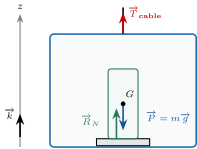
- The system \{cabin of mass \} is subjected to its weight and to the tension of the cable . Newton's second law projected onto oriented upward gives:
- Phase 1 (): .
- Phase 2 (): .
- Phase 3 (): .
- The system \{passenger of mass \} is subjected to its weight and to the normal reaction of the scale . Newton's second law projected onto likewise gives:
- Phase 1: (the scale displays : feeling of being heavier when starting upward).
- Phase 2: (the scale displays the true mass ).
- Phase 3: (the scale displays : feeling of being lighter when braking at the top).
Similar exercises
- System of two solids coupled by a string and a pulley on an inclined plane solved
- Equilibrium of a solid held by a spring on an inclined plane solved
- Equilibrium of a light fixture hanging from two cables solved
- Driving force and friction force of an automobile solved
- Dynamic study of a skier on an inclined slope solved
The course of the chapter · All the exercises of the chapter