Physics (Grade 10, Lebanon) · Chapter 11 · Tutorial exercise
Melde's string driven by a vibrator, stroboscopy and wave profile
Vibrations and waves · B. Progressive and periodic mechanical waves · level 3 (hard)
Statement
During a lab session, the end of a long horizontal string of linear mass density is attached to a vibrating blade driven by an electromagnet. The other end of the string passes over the groove of a frictionless pulley and supports a marked mass that keeps the string stretched (); a cotton sleeve placed before the pulley absorbs the wave in order to avoid any return.
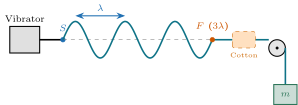
- Calculate the magnitude of the tension of the string at equilibrium of the hanging mass, then deduce the speed of the transverse waves along the string.
- To determine the frequency of the vibrator, the string is illuminated with a stroboscope. Starting from the maximum frequency of the stroboscope () and gradually decreasing it, we observe that the string takes on the appearance of a single frozen sinusoid (apparent stillness) for the successive flash frequencies: , , , ... a) Deduce the frequency and the period of the progressive wave along the string. b) Calculate the wavelength on the string.
- The flash frequency of the stroboscope is set to . What is then observed on the string? In which direction do the crests seem to propagate and what is their apparent speed ?
- The vibrator having started to operate at at the instant , consider two points and of the string located at the abscissas and from . a) At which instants and do the points and start to vibrate? b) What is the vibratory state of relative to once the wave has passed ? c) Determine the abscissas of all the points of the segment that vibrate in phase with the source .
Solution
- Since the mass is in equilibrium at the end of the string, the tension of the string balances its weight: According to Taylor's formula, the speed of the transverse wave along the string is: To obtain an exact whole value in the rest of the lab session, the teacher adds an extra load of , bringing the total mass to , that is, , which gives: (Let us use for the whole of the rest of the study.)
- a) The flash frequencies giving a single motionless sinusoid are of the form (). The highest of them () gives the frequency of the vibrator: b) The wavelength on the string is then:
- For , the period of the flashes is slightly greater than . We observe a sinusoid that seems to propagate in slow motion in the actual direction of propagation (from toward the pulley), at the apparent frequency . In one apparent period , each crest advances by one wavelength , that is, an apparent speed:
- a) The delays of () and () relative to the source are: b) The distance between and is . The ratio is neither an integer nor a half-integer: the points and vibrate neither in phase nor in phase opposition (they are said to be out of phase). c) A point of abscissa vibrates in phase with if and only if (in ) with an integer: There are therefore exactly two points on that vibrate in phase with , located at the abscissas and .
What the exercise establishes: Combine the tension dynamics of a string (, ), the stroboscopic measurement of the frequency (, apparent slow motion) and the spatial periodicity ().
Similar exercises
- Stroboscopy of a fan with several blades solved
- Propagation of a disturbance along a string and Taylor's law solved
- Marine sonar and acoustic echo solved
- Comparison of the vibratory state of points at the surface of a ripple tank solved
- Seismograph and location of the epicenter of an earthquake solved
The course of the chapter · All the exercises of the chapter