Physics (Grade 10, Lebanon) · Chapter 11 · Tutorial exercise
Stroboscopic analysis of a vibrating blade
Vibrations and waves · A. Periodic vibratory motions and stroboscopic observation · level 1 (application)
Statement
A steel blade vibrating periodically has its free end oscillating vertically between two extreme positions and a distance apart. To determine its frequency , it is illuminated with a stroboscope whose flash frequency is adjustable between and . By gradually decreasing from , the first apparent stillness of the blade with a single image is obtained for .
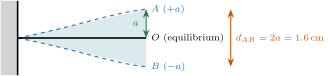
- What is the amplitude of the vibrations of the end of the blade? What distance does this end travel in one second?
- Determine the actual frequency and the period of the vibrating blade, then give the next three values of the flash frequency () that give single apparent stillness.
- Describe precisely what the observer sees when the frequency of the stroboscope is set to: a) ; b) ; c) .
Solution
- The distance between the two extreme positions (peak to peak) is twice the amplitude :
- The highest flash frequency giving apparent stillness with a single image () is equal to the actual frequency of the blade: During one period , the end travels . In one second ( periods), it therefore travels: The next frequencies giving single apparent stillness ( for ) are:
- Let us analyze the three settings:
- a) (): there are two flashes per period of vibration; we observe simultaneously two fixed images of the blade in symmetric positions (double apparent stillness).
- b) : since is slightly less than (), we observe the blade in apparent slow motion in the actual direction, of apparent frequency (that is, an apparent period ).
- c) : since is slightly greater than (), we observe an apparent slow motion in the reverse direction (backward), of apparent frequency .
What the exercise establishes: Distinguish the amplitude from the total travel , identify and interpret the multiple frequencies () or those close to .
Similar exercises
- Stroboscopy of a fan with several blades solved
- Propagation of a disturbance along a string and Taylor's law solved
- Marine sonar and acoustic echo solved
- Comparison of the vibratory state of points at the surface of a ripple tank solved
- Seismograph and location of the epicenter of an earthquake solved
The course of the chapter · All the exercises of the chapter