Physics (Grade 10, Lebanon) · Chapter 13 · Direct application of the course
Minimum height of a plane mirror to see oneself in full
Propagation of light · level 3 (hard)
Statement
A standing person, modeled as a vertical segment of total height ( denoting the feet on the ground and the top of the head), has their eyes located at the height above the ground (hence below the top of the head). The person looks at themselves in a vertical plane mirror fixed against a wall at a horizontal distance in front of them.
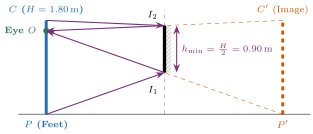
- Considering the symmetric image of the person in the mirror and the two extreme rays and that enter the eye , determine using the midpoint theorem (or Thales' theorem) the minimum height that the mirror must have for the person to see themselves entirely from feet to head.
- At what height above the ground must the lower edge of the mirror be placed? Do these results depend on the distance from the person to the mirror?
Solution
- For the eye to see the image of the feet and the image of the top of the head, the mirror must contain the point of incidence where the line intersects the plane of the mirror, and the point of incidence where the line intersects the plane of the mirror. In the large triangle , the plane of the mirror is parallel to the segment and passes exactly halfway between the point (at the distance in front of the mirror) and the segment (at the distance behind the mirror). By the midpoint theorem (Thales with a ratio ), the segment cut on the mirror is exactly half of :
- Similarly, in the triangle , the point is halfway in height between the ground (level of and ) and the eye : the lower edge of the mirror must be placed at the height:
Neither of these two results depends on the distance between the person and the mirror!
Similar exercises
- Multiple images in two perpendicular or parallel plane mirrors solved
- Light-year, Earth-Sun propagation time and index solved
- Measuring the height of a building with a pinhole camera solved
- Cast shadow and penumbra of an opaque disk solved
- Moving an object or a plane mirror solved
The course of the chapter · All the exercises of the chapter