Physics (Grade 10, Lebanon) · Chapter 13 · Tutorial exercise
Multiple images in two perpendicular or parallel plane mirrors
Propagation of light · B. Laws of reflection and formation of images in a plane mirror · level 3 (hard)
Statement
This problem studies the formation of multiple images of a point light source placed between two plane mirrors and .
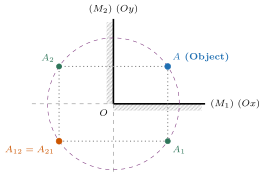
- First configuration: perpendicular mirrors (). The mirror is placed along the half-axis () and the mirror along the half-axis (). A point object is placed at the point of coordinates and . a) Determine the coordinates of the primary image of by reflection on alone, and of the primary image of by reflection on alone. b) The rays reflected by (which seem to come from ) can in turn meet the mirror and be reflected on it: then plays the role of object for and gives a secondary image . Determine the coordinates of and check that it coincides with the image of in . How many distinct images of are seen in total in two perpendicular mirrors? c) Calculate the distances of , , and from the edge and show that the object and its three images belong to the same circle of center .
- Second configuration: parallel mirrors facing each other. The two mirrors and are now vertical, parallel to each other and separated by a distance . The source is placed between the two mirrors, at from and at from . Determine the distance between and the first two images formed behind (the primary image , then the secondary image , which is the image of by ). How many images are formed theoretically?
Solution
- Let us study the right dihedral formed by and with :
- a) The orthogonal symmetric of with respect to () is: The orthogonal symmetric of with respect to () is:
- b) The symmetric of with respect to the plane of () is: which coincides exactly with the symmetric of with respect to (): it is the point symmetric of with respect to the edge . An observer therefore sees in total distinct virtual images (, and ) of the object .
- c) Since , we have: The object and its three images are the four vertices of a rectangle inscribed in the circle of center and radius .
- For the two parallel mirrors apart, with located at from and from :
- The primary image of in is located behind , hence at the distance from :
- On the other hand, the primary image of in is located behind . Its distance to the mirror is therefore . The mirror then gives of a secondary image located behind , that is, at a distance from the object equal to: Through successive reflections from one mirror to the other, an infinity of images is theoretically formed, aligned on the common perpendicular to the two mirrors.
What the exercise establishes: Understand the principle of secondary images (the virtual image given by a first mirror serves as an object for the second mirror) for two perpendicular or parallel mirrors.
Similar exercises
- Pinhole camera with variable depth solved
- Shadow cone, cast shadow and penumbra solved
- Reflection of a light ray and construction of the point of incidence solved
- Rotation of a plane mirror and optical lever solved
- Field of view of a plane mirror and visibility of an object solved
The course of the chapter · All the exercises of the chapter