Physics (Grade 10, Lebanon) · Chapter 13 · Tutorial exercise
Pinhole camera with variable depth
Propagation of light · A. Speed of light, refractive index, pinhole camera and shadows · level 2
Statement
A pinhole camera is made of two sliding boxes that make it possible to vary the distance (depth) between the pinhole pierced in the front face and the tracing-paper screen fixed on the back face. The camera is aimed at a vertical tree of unknown height located at a distance in front of the pinhole .
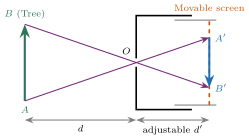
- When the depth is set to and the pinhole is at the distance from the tree, the inverted image on the screen measures . Calculate the real height of the tree.
- Keeping the device at the same distance from the tree, what depth must be given to the pinhole camera for the image to have a height ?
- To increase the brightness of the image on the screen, a student replaces the point-like pinhole by a circular hole of diameter . What defect then appears on the screen? Calculate the diameter of the light spot formed by each point of the tree on the screen when and .
Solution
- According to Thales' theorem applied to the similar triangles and :
- For fixed and , the size of the image is directly proportional to the depth :
- If the hole has a non-negligible diameter , the narrow beam of light coming from a single point of the tree is a cone that projects on the screen a circular spot instead of a point: the image becomes brighter but blurred. By Thales' theorem, the diameter of the spot produced by a point located at is:
What the exercise establishes: Apply the Thales relation of the pinhole camera () and justify the fundamental trade-off between the fineness of the hole (sharpness) and brightness.
Similar exercises
- Speed of light, refractive index and light-year solved
- Shadow cone, cast shadow and penumbra solved
- Reflection of a light ray and construction of the point of incidence solved
- Rotation of a plane mirror and optical lever solved
- Field of view of a plane mirror and visibility of an object solved
The course of the chapter · All the exercises of the chapter