Physics (Grade 10, Lebanon) · Chapter 13 · Tutorial exercise
Rotation of a plane mirror and optical lever
Propagation of light · B. Laws of reflection and formation of images in a plane mirror · level 2
Statement
A fixed laser beam reaches a plane mirror at the point of incidence at an angle of incidence . The reflected ray forms a light spot on a graduated ruler perpendicular to the reflected ray and located at the distance from the point .
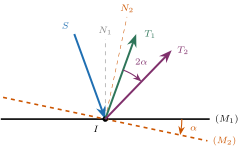
- What is the angle between the incident ray and the reflected ray ?
- Without moving the incident laser beam , the mirror is rotated by an angle about an axis passing through (in the plane of the figure). a) Through what angle does the normal to the mirror then turn? Deduce the new angle of incidence and the new angle between the incident ray and the new reflected ray . b) Prove that the reflected ray has turned through an angle , twice the angle of rotation of the mirror. c) Numerical application: the light spot is observed to have moved by on the ruler located at . Calculate the angle of rotation of the reflected ray, then the angle of the very small rotation undergone by the mirror.
Solution
- According to the second law of reflection, . The angle between the incident ray and the reflected ray is:
- Let us study the effect of a rotation of the mirror:
- a) Since the normal is attached to the mirror, it turns through exactly the same angle as the mirror. Since the incident ray is fixed, the new angle of incidence becomes , and the new angle of reflection is . The angle between the fixed incident ray and the new reflected ray becomes:
- b) Since the direction of the incident ray is fixed, the angle through which the reflected ray has turned is: When a plane mirror turns through an angle , the reflected ray turns through twice that angle, .
- c) In the right triangle : The angle of rotation of the mirror is therefore half of it: This device (called an optical lever) makes it possible to measure tiny rotations with very great precision.
What the exercise establishes: Prove and use the rotation theorem of the plane mirror () and its application to the optical amplification of small angles.
Similar exercises
- Pinhole camera with variable depth solved
- Shadow cone, cast shadow and penumbra solved
- Reflection of a light ray and construction of the point of incidence solved
- Field of view of a plane mirror and visibility of an object solved
- Multiple images in two perpendicular or parallel plane mirrors solved
The course of the chapter · All the exercises of the chapter