Physics (Grade 10, Lebanon) · Chapter 14 · Tutorial exercise
Floating opaque disk making a submerged source invisible
Refraction of light · A. Snell-Descartes laws, critical angle and total internal reflection · level 2
Statement
At the bottom of a pool containing a height of a transparent liquid of refractive index lies a small point-like light bulb that emits light in all directions toward the free surface in contact with the air ().
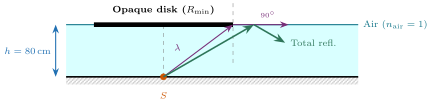
- Calculate the critical angle of the liquid/air interface.
- What happens to the light rays coming from that strike the free surface with an angle of incidence ?
- A circular opaque disk of center , located exactly vertically above the source , is placed on the surface of the liquid. What minimum radius must this opaque disk have so that no ray coming from can get out into the air (making the bulb completely invisible to any observer located above the pool)?
Solution
- Since light passes from the liquid () into the less refractive air (), the critical angle is given by:
- For any angle of incidence , there is no longer a refracted ray in the air: the light undergoes total internal reflection at the free surface and goes back toward the bottom of the pool.
- Consequently, only the rays coming from with an angle of incidence can cross the surface and get out into the air. These rays form a cone with vertical axis and half-angle at the vertex , which cuts out on the surface of the liquid a bright disk of center and radius . With , we have and : If the opaque disk covers this circle of radius , all the rays with are blocked by the disk and all the rays with undergo total internal reflection: no ray at all gets out into the air!
What the exercise establishes: Understand that all the light that can emerge from a submerged source passes through a disk of radius with .
Similar exercises
- Refraction at a plane interface and displacement of the spot on the bottom of a pool solved
- Parallel-sided slab and layered medium solved
- Path of a ray in a prism and calculation of the deviation solved
- Total-reflection prism and depositing a drop of liquid solved
- Grazing incidence on a prism and refractometer solved
The course of the chapter · All the exercises of the chapter