Physics (Grade 10, Lebanon) · Chapter 14 · Tutorial exercise
Refraction at a plane interface and displacement of the spot on the bottom of a pool
Refraction of light · A. Snell-Descartes laws, critical angle and total internal reflection · level 1 (application)
Statement
A pool with a flat horizontal bottom is filled with water of refractive index to a height . A narrow laser beam propagating in air () strikes the free surface of the water at a point with an angle of incidence ( and ).
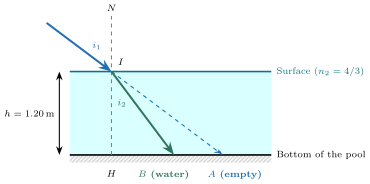
- When the pool is empty (filled with air only), the laser beam continues its path in a straight line and strikes the bottom of the pool at a point . Calculate the horizontal distance between the vertical passing through ( being the orthogonal projection of on the bottom) and the point .
- When the pool is filled with water to the height : a) Calculate the angle of refraction of the beam in the water as well as the angle of deviation . b) The refracted ray then touches the bottom of the pool at a point . Calculate the distance , then the distance by which the light spot on the bottom of the pool moved when the pool was filled with water.
Solution
- When the pool is empty, in the triangle , right-angled at , the angle at is equal to ():
- a) When crossing the air/water interface at , the second Snell-Descartes law is written: We deduce the angle of refraction in the water: The angle of deviation is: b) In the triangle , right-angled at , the angle at is now : When the pool was filled with water, the ray bent toward the normal and the light spot on the bottom moved closer to by a distance:
What the exercise establishes: Combine the second Snell-Descartes law () with trigonometry in right triangles () to calculate the displacement of a refracted beam.
Similar exercises
- Floating opaque disk making a submerged source invisible solved
- Parallel-sided slab and layered medium solved
- Path of a ray in a prism and calculation of the deviation solved
- Total-reflection prism and depositing a drop of liquid solved
- Grazing incidence on a prism and refractometer solved
The course of the chapter · All the exercises of the chapter