Physics (Grade 10, Lebanon) · Chapter 14 · Direct application of the course
Step-index optical fiber
Refraction of light · level 2
Statement
A straight optical fiber consists of a cylindrical glass core of index surrounded by an optical cladding of index . The flat entry face of the fiber, perpendicular to the axis of the cylinder, is immersed in air of index . A light ray arrives from the air at the center of the entry face at an angle of incidence , is refracted in the core at an angle , then strikes the core/cladding side wall at at an angle of incidence .
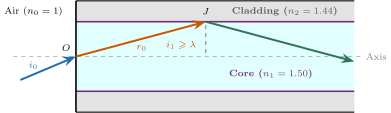
- Calculate the critical angle at the core/cladding interface for total internal reflection to occur at .
- What relation links the angles and in the triangle right-angled at ? Deduce the maximum value of , then the maximum value of the angle of incidence in air (acceptance cone of the fiber) for the ray to be guided by total internal reflection in the core.
Solution
- At the interface between the core () and the cladding (), the critical angle satisfies:
There is total internal reflection at if and only if .
- Since the entry face is perpendicular to the cylindrical core/cladding wall, their normals are perpendicular, so and are complementary: . The condition is therefore equivalent to:
(More exactly, .) Finally, let us apply the Snell-Descartes law on the entry face at ( with ):
Any ray entering the fiber with is entirely trapped and guided in the core.
Similar exercises
- Optical characterization of a flint glass prism for two radiations solved
- Simultaneous refraction and reflection at an air/glass interface solved
- Critical angle and cone of vision of a diver under water solved
- Crossing an equilateral prism and minimum deviation solved
- Dispersion of a narrow beam of white light by a prism solved
The course of the chapter · All the exercises of the chapter