Physics (Grade 10, Lebanon) · Chapter 14 · Tutorial exercise
Total-reflection prism and depositing a drop of liquid
Refraction of light · B. Study of the prism · level 2
Statement
A glass prism of index has as its cross-section an isosceles right triangle , right-angled at (, ). It is placed in air (). A monochromatic light ray arrives in the air perpendicular to the entry face ().
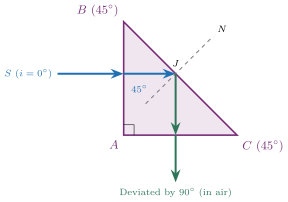
- Explain why the ray crosses the face without deviation, then determine the angle of incidence at which it strikes the hypotenuse face at a point .
- By comparing with the critical angle of the glass/air interface, show that the ray undergoes total internal reflection at , specify through which face it leaves the prism and calculate the total deviation undergone.
- A large drop of a transparent liquid of unknown index is deposited on the hypotenuse face , at the point . What is the minimum index that this liquid must have for the total internal reflection at to disappear and for part of the light beam to be refracted into the drop?
Solution
- Since the ray reaches the face at normal incidence (), we have : it enters the prism without being deviated, perpendicular to . Since the hypotenuse makes an angle with the face , the normal to at also makes an angle of with the perpendicular to : the angle of incidence at on the face is therefore:
- For the glass/air interface, . Since , the ray undergoes total internal reflection at with an angle of reflection . The ray reflected at has therefore turned through and heads perpendicularly toward the face (), which it crosses at normal incidence () without further deviation. The total deviation is .
- When the drop of index covers the point , the new critical angle of the glass/liquid interface satisfies . For refraction into the drop to occur (suppression of the total internal reflection), the angle of incidence must become less than or equal to : Numerical application: (This is the principle of optical rain sensors on car windshields: water, of index , suppresses the total internal reflection and makes the intensity of the beam reflected toward the sensor drop!)
What the exercise establishes: Master the operation of the total-reflection prism () and understand how replacing air by a liquid modifies the critical angle .
Similar exercises
- Floating opaque disk making a submerged source invisible solved
- Parallel-sided slab and layered medium solved
- Path of a ray in a prism and calculation of the deviation solved
- Grazing incidence on a prism and refractometer solved
- Optical characterization of a flint glass prism for two radiations solved
The course of the chapter · All the exercises of the chapter