Physics (Grade 10, Lebanon) · Chapter 2 · Direct application of the course
Applying the loop law and the equality of voltages in parallel
Electric voltage · level 1 (application)
Statement
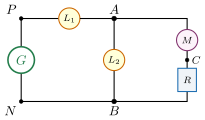
An electric circuit includes a generator with terminals and (). Between and , a lamp (between and a junction ) and a lamp (between junction and a junction ) are connected in series, junction being directly connected to terminal by a connecting wire. In parallel across lamp (between and ), a motor and a resistor are connected in series (with an intermediate point between and ). We measure across and across motor .
- Determine the voltage across the wire connecting to .
- Apply the loop law to calculate the voltage across lamp .
- Deduce the voltage across resistor .
Solution
- Since points and are connected by a simple connecting wire, the voltage across it is zero: (so ).
- In the main loop , the law of addition of voltages (or the loop law ) gives:
The voltage across lamp is therefore .
- The branch containing motor and resistor in series is connected in parallel between junctions and . According to the law of addition of voltages between and :
Similar exercises
- Complete diagnosis of a circuit and dual-trace display without a ground short circuit solved
- Electric potentials and ground reference solved
- Choice of range and reading of an analog voltmeter solved
- Complete analysis of an oscillogram solved
- Ground precaution when connecting an oscilloscope solved
The course of the chapter · All the exercises of the chapter