Physics (Grade 10, Lebanon) · Chapter 2 · Tutorial exercise
Comparison of a square-wave voltage and a sinusoidal voltage of the same frequency
Electric voltage · B. Display on the oscilloscope · level 2
Statement
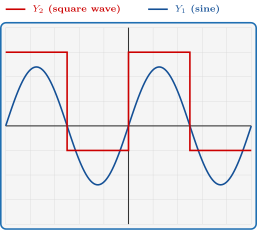
On the two channels and of a dual-trace oscilloscope whose time base is set to , two periodic voltages and are displayed simultaneously:
- Channel (): a sinusoidal alternating voltage whose vertical amplitude is and of which one basic pattern occupies .
- Channel (): a periodic square-wave (rectangular) voltage with the same period as . Over each period , the voltage stays constant at an upper level located above the central axis for half a period (), then stays constant at a lower level located below the central axis for the second half-period ().
- Calculate the common period (in , in then in ) and the frequency (in ) of the two signals.
- Calculate the maximum value and the effective value of the sinusoidal voltage .
- For the square-wave voltage : a) Determine the value of the voltage of the upper level , that of the lower level and the peak-to-peak voltage . b) Is the voltage symmetric about zero? Explain why the formula does not apply to .
Solution
- One basic pattern occupies with . The period is: The frequency common to the two voltages is:
- For the sinusoidal voltage on channel ():
- a) For the square-wave voltage on channel ():
- Upper level (): .
- Lower level (): .
- Peak-to-peak voltage: . b) The voltage oscillates between and : it is not symmetric about (it has an average DC component of ). Moreover, the relation is a mathematical property specific to the sinusoidal waveform and does not apply to rectangular or triangular signals.
What the exercise establishes: Read two oscilloscope channels with different vertical sensitivities simultaneously and remember that the relation is reserved for sinusoidal alternating voltages.
Similar exercises
- Loop law and voltages across switches in a mixed circuit solved
- Solving a bridge network (Wheatstone bridge) solved
- Complete reading of a sinusoidal oscillogram and AC voltmeter measurement solved
- Choice of oscilloscope settings to analyze an acoustic signal solved
- Complete diagnosis of a circuit and dual-trace display without a ground short circuit solved
The course of the chapter · All the exercises of the chapter