Physics (Grade 10, Lebanon) · Chapter 2 · Tutorial exercise
Complete reading of a sinusoidal oscillogram and AC voltmeter measurement
Electric voltage · B. Display on the oscilloscope · level 2
Statement
An oscilloscope and a digital voltmeter are connected across a low-frequency generator (LFG) delivering a sinusoidal alternating voltage . The oscilloscope settings are as follows:
- Vertical sensitivity: ;
- Sweep speed (horizontal sensitivity): .
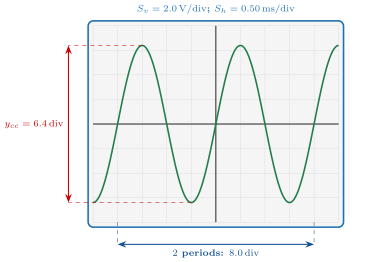
On the grid screen ( horizontal divisions vertical divisions), the light trace is perfectly centered around the horizontal axis. We read:
- The vertical distance between an upper peak (maximum) and a lower peak (minimum) is .
- Two complete basic patterns ( periods) occupy exactly horizontally.
- Determine the peak-to-peak voltage and the amplitude (maximum value) of the voltage .
- What value does the digital voltmeter display if it is set to AC mode ()? What value would it display if it were mistakenly set to DC mode ()?
- Determine the number of divisions corresponding to a single period, then calculate the period (in and in ) and the frequency of the voltage delivered by the LFG.
- Without changing the LFG settings, the student turns the knobs of the oscilloscope to switch to and . Calculate the new amplitude in divisions and the number of complete periods now visible over the horizontal divisions of the screen.
Solution
- The peak-to-peak voltage is: The amplitude (maximum value) is half the peak-to-peak voltage (corresponding to ): 2.
- In AC mode (), the voltmeter measures the effective value of the sinusoidal voltage:
- In DC mode (), a voltmeter measures the average value of the voltage. Now, a symmetric alternating voltage has a zero average value: the voltmeter would display .
- Since periods occupy , a single period occupies: The period is therefore: The frequency of the voltage is the reciprocal of the period expressed in seconds:
- Since the LFG was not touched, and remain unchanged:
- With , the new maximum vertical deflection is:
- With , the horizontal width of one period becomes: Over the total width of the screen (), we therefore observe complete periods.
What the exercise establishes: Methodically analyze an oscillogram (, , , ) and clearly distinguish the quantities belonging to the LFG signal (which do not depend on the oscilloscope) from the geometric appearance of the trace on the screen (which depends on and ).
Similar exercises
- Loop law and voltages across switches in a mixed circuit solved
- Solving a bridge network (Wheatstone bridge) solved
- Comparison of a square-wave voltage and a sinusoidal voltage of the same frequency solved
- Choice of oscilloscope settings to analyze an acoustic signal solved
- Complete diagnosis of a circuit and dual-trace display without a ground short circuit solved
The course of the chapter · All the exercises of the chapter