Physics (Grade 10, Lebanon) · Chapter 2 · Tutorial exercise
Solving a bridge network (Wheatstone bridge)
Electric voltage · A. Potentials, voltmeter measurement and laws of voltages · level 2
Statement
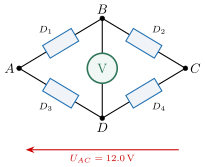
A bridge network (called a Wheatstone bridge) is supplied between two junctions and by a generator maintaining a fixed voltage :
- A first branch between and has two dipoles (between and ) and (between and ).
- A second branch in parallel between and has two dipoles (between and ) and (between and ).
- A high-precision voltmeter is connected on the diagonal of the bridge between the middle junctions and ( terminal at , terminal at ).
- In a first configuration, we measure and . a) Calculate the voltages and . b) By applying the loop law to the triangular loop , determine the voltage displayed by the voltmeter. c) Find the value of again using the lower triangular loop .
- What condition must the voltages and satisfy for the bridge to be said to be “balanced”, that is, for the voltmeter connected between and to read ? If at balance, what are then , and ?
Solution
- a) The two branches and are subjected to the same voltage . By addition of voltages:
- In branch : .
- In branch : . b) In the upper loop , we have (or ), hence: The voltmeter ( terminal at , at ) therefore displays . c) In the lower loop , we have , hence: The two loops naturally lead to the same result.
- The bridge is balanced if and only if , that is, . Since , the balance condition is written: If at balance, then and .
What the exercise establishes: Apply the loop law in a non-rectangular geometry (triangular loops of a bridge) and interpret a zero transverse voltage as an equality of potentials ().
Similar exercises
- Electric potentials, change of ground and polarity of a voltmeter solved
- Loop law and voltages across switches in a mixed circuit solved
- Complete reading of a sinusoidal oscillogram and AC voltmeter measurement solved
- Comparison of a square-wave voltage and a sinusoidal voltage of the same frequency solved
- Choice of oscilloscope settings to analyze an acoustic signal solved
The course of the chapter · All the exercises of the chapter