Physics (Grade 10, Lebanon) · Chapter 3 · Tutorial exercise
Determining the direction and the value of unknown currents in a meshed network
Electric current · B. Law of uniqueness in series and junction law · level 2
Statement
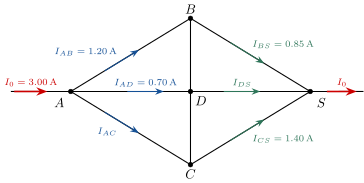
Consider an electrical network comprising four junctions , , and connected as follows:
- The main current coming from the pole of the generator enters the network through junction .
- Three branches leave : a branch toward carrying (from to ), a direct central branch toward carrying (from to ), and a branch toward carrying a current (from to ).
- From junction leaves an outer branch toward the exit of the network carrying (from to ), and a transverse branch connecting and .
- From junction leaves an outer branch toward the exit carrying (from to ), and a transverse branch connecting and .
- Finally, from junction leaves a branch toward the exit carrying a current (from to ). At the exit junction , the three currents , and meet to return to the pole of the generator.
- Apply the junction law at junction to determine the current .
- Study junction to determine the actual direction (from to or from to ) and the current in the branch .
- Study junction to determine the actual direction (from to or from to ) and the current in the branch .
- By applying the junction law at junction , calculate the current , then check that the sum of the currents arriving at the exit junction is indeed equal to .
Solution
- At junction : The incoming current is ; the outgoing currents are , and . According to the junction law:
- At junction : The current enters , and the current leaves . Since , the excess current must necessarily leave junction toward junction :
- At junction : The current enters , while the current leaves . Since the outgoing current is greater than the incoming current , the branch must necessarily supply the difference by entering (hence flowing from to ):
- At junction :
- Currents entering : (coming from ) and (coming from ), that is, an incoming sum of .
- Currents leaving : (going to ) and (going to ). The junction law at gives: Check at the exit junction : The overall conservation of the current between the entry and the exit of the network is perfectly verified.
What the exercise establishes: Determine both the actual direction of flow and the value of an unknown current in a transverse branch by a simple inflow/outflow balance at a junction.
Similar exercises
- Double ionic migration in an electrolyzer and metal deposit solved
- Capacity of a storage battery in ampere-hours and charge/discharge cycles solved
- Distribution of the currents in a network with multiple parallel branches solved
- Microscopic drift velocity of the free electrons in a copper wire solved
- Joint study of loops, junctions and an electrolysis cell in parallel solved
The course of the chapter · All the exercises of the chapter