Physics (Grade 10, Lebanon) · Chapter 3 · Tutorial exercise
Distribution of the currents in a network with multiple parallel branches
Electric current · B. Law of uniqueness in series and junction law · level 2
Statement
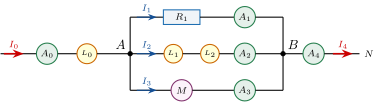
A direct-current generator supplies a circuit comprising a main branch (containing an ammeter and an indicator lamp ) which splits at junction into three branches connected in parallel between junctions and :
- Branch 1: contains a resistance and an ammeter in series.
- Branch 2: contains two lamps and connected in series with an ammeter .
- Branch 3: contains a motor and an ammeter in series.
From junction , a single wire returns to the negative terminal of the generator through an ammeter . The following readings are recorded: displays ; displays ; displays .
- What is the current through the indicator lamp , and what is the reading of the ammeter ? Justify by citing the law used.
- By applying the junction law at junction , calculate the current displayed by the ammeter .
- Compare the current through the lamp and that through the lamp in branch 2.
- If the lamp burns out (its filament breaks and behaves like an open switch), what does the current in branch 2 become? Assuming that the currents and of the other parallel branches remain unchanged, what is the new reading of the main ammeter ?
Solution
- The indicator lamp , the ammeter and the return ammeter all belong to the main branch (in series with the generator). According to the law of uniqueness of the current in a series branch:
- Let us convert to amperes: . At junction , the incoming current is and the outgoing currents are , and . The junction law at gives:
- In branch 2, the two lamps and and the ammeter are connected in series without any intermediate junction: they therefore carry the same current .
- If the filament of breaks, branch 2 becomes an open circuit: no current can flow in branch 2 any longer (neither in nor in ), so: According to the junction law at , the new main current delivered by the generator is then:
What the exercise establishes: Combine the uniqueness of the current within each branch and the additivity of the currents at the junctions, and predict the effect of opening a parallel branch.
Similar exercises
- Double ionic migration in an electrolyzer and metal deposit solved
- Capacity of a storage battery in ampere-hours and charge/discharge cycles solved
- Determining the direction and the value of unknown currents in a meshed network solved
- Microscopic drift velocity of the free electrons in a copper wire solved
- Joint study of loops, junctions and an electrolysis cell in parallel solved
The course of the chapter · All the exercises of the chapter