Physics (Grade 10, Lebanon) · Chapter 3 · Tutorial exercise
Double ionic migration in an electrolyzer and metal deposit
Electric current · A. Microscopic nature of the current, rate of flow of charge and measurement of intensity · level 2
Statement
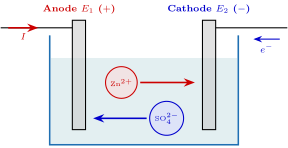
A series circuit comprises a DC voltage generator, a closed switch, an ammeter and an electrolysis cell containing an aqueous solution of zinc sulfate in which two electrodes are immersed: the electrode connected to the positive pole of the generator (anode) and the electrode connected to the negative pole of the generator (cathode). Given: and the mass of a zinc atom .
- Explain how the passage of the electric current is ensured in the metal wires on the one hand, and inside the electrolytic solution on the other hand. Specify the direction of migration of the ions and of the ions.
- At the surface of the cathode , each cation arriving from the solution captures two electrons supplied by the metal circuit according to the electronic half-equation: The electrolysis is maintained at constant current for a time . a) Calculate the quantity of electricity that has flowed in the circuit and the number of electrons supplied to the cathode . b) Deduce the number of zinc atoms formed and the mass of solid zinc deposited on the cathode .
Solution
1.
- In the metal wires: The current is carried exclusively by the free electrons, which flow from the pole of the generator to the cathode , and from the anode to the pole of the generator.
- In the electrolytic solution: There are no free electrons; the current is carried by a double ionic migration:
- The cations () move in the conventional direction of the current, that is, from to the cathode ().
- The anions () move in the direction opposite to the conventional direction, that is, from to the anode ().
- a) Let us convert the time to seconds: . The quantity of electricity involved is: The number of electrons that arrived at the cathode during this time is: b) According to the equation , the formation of a single zinc atom consumes electrons. The number of zinc atoms deposited is therefore: The total mass of zinc deposited on the electrode is then:
What the exercise establishes: Understand the continuity of the electric current at the metal/electrolytic solution interface and quantitatively relate the current to the electron stoichiometry of an electrolysis.
Similar exercises
- Electron current in a copper wire and microscopic flow rate solved
- Capacity of a storage battery in ampere-hours and charge/discharge cycles solved
- Distribution of the currents in a network with multiple parallel branches solved
- Determining the direction and the value of unknown currents in a meshed network solved
- Microscopic drift velocity of the free electrons in a copper wire solved
The course of the chapter · All the exercises of the chapter