Physics (Grade 10, Lebanon) · Chapter 4 · Tutorial exercise
Methodical reduction of a mixed network of five ohmic conductors
Ohmic conductors · A. Ohm's law, current–voltage characteristic and combinations of resistors · level 2
Statement
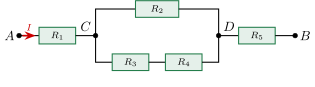
Consider a passive dipole between two main terminals and , made up of five ohmic conductors arranged as follows:
- A resistor is connected between the input terminal and a junction .
- Between junction and a junction are connected two parallel branches:
- the upper branch contains a single resistor ;
- the lower branch contains two resistors in series and .
- Finally, a resistor is connected between junction and the output terminal .
A constant DC voltage is applied between terminals and .
- Calculate the resistance of the lower branch between and , then the equivalent resistance between junctions and , and finally the overall equivalent resistance of the dipole .
- Calculate the main current that enters at and leaves at , then determine the voltages , and .
- Calculate the current through and the current through the series branch , then determine the voltage across the resistor alone.
Solution
- Let us proceed by progressive reduction of the sub-groupings:
- In the lower branch between and , the resistors and are in series:
- Between junctions and , the resistor and the assembly are connected in parallel:
- Between and , the resistor , the equivalent block and the resistor are connected in series:
- The main current is obtained by applying Ohm's law to the overall equivalent dipole : This main current flows successively through , the equivalent block and , hence:
- ;
- ;
- . (Check by the law of addition of voltages: ).
- The two parallel branches between and are subjected to the same voltage :
- In the upper branch ():
- In the lower branch (): (The junction law at is indeed verified: ).
- The voltage across is then:
What the exercise establishes: Apply the “there-and-back” method to a mixed circuit: reduce from the inside outward to find and , then work back down from the main branches to the sub-branches to determine each voltage and each current.
Similar exercises
- Using characteristics , conductance and color code solved
- Building an equivalent resistance from identical resistors solved
- Potentiometer connected as a voltage divider, with no load and under load solved
- Heating by the Joule effect, thermal efficiency and energy cost solved
- Energy comparison of two resistors combined in series then in parallel solved
The course of the chapter · All the exercises of the chapter