Physics (Grade 10, Lebanon) · Chapter 4 · Tutorial exercise
Using characteristics , conductance and color code
Ohmic conductors · A. Ohm's law, current–voltage characteristic and combinations of resistors · level 1 (application)
Statement
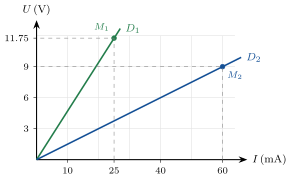
During a lab session, a group of students records the current–voltage characteristics , in the receiver convention, of two ohmic conductors and and obtains two straight lines passing through the origin:
- The line associated with passes through the point .
- The line associated with passes through the point .
- Calculate the resistances and (in ) as well as the conductances and (in millisiemens, ) of the two ohmic conductors. Which of the two dipoles has the steeper slope on the graph ?
- Recall the color code: Black (), Brown (), Red (), Orange (), Yellow (), Green (), Blue (), Violet (). Determine, in order, the colors of the first three bands painted on and on .
- Each of these two resistors can dissipate at most a thermal power by the Joule effect without being damaged. Calculate the maximum current and the maximum voltage allowable for .
Solution
- Converting the currents to amperes ( and ), Ohm's law gives:
- For :
- For : On the graph (where is on the horizontal axis and on the vertical axis), the slope of the line is equal to the resistance : since , it is the line of that has the steeper slope. 2.
- For : Yellow, Violet, Brown.
- For : Brown, Green, Brown.
- According to Joule's law with and :
What the exercise establishes: Relate the slope of the characteristic to the resistance , go from to the conductance and to the color code, and calculate the thermal operating limits of a resistor.
Similar exercises
- Methodical reduction of a mixed network of five ohmic conductors solved
- Building an equivalent resistance from identical resistors solved
- Potentiometer connected as a voltage divider, with no load and under load solved
- Heating by the Joule effect, thermal efficiency and energy cost solved
- Energy comparison of two resistors combined in series then in parallel solved
The course of the chapter · All the exercises of the chapter